Table of Contents
ToggleTL;DR
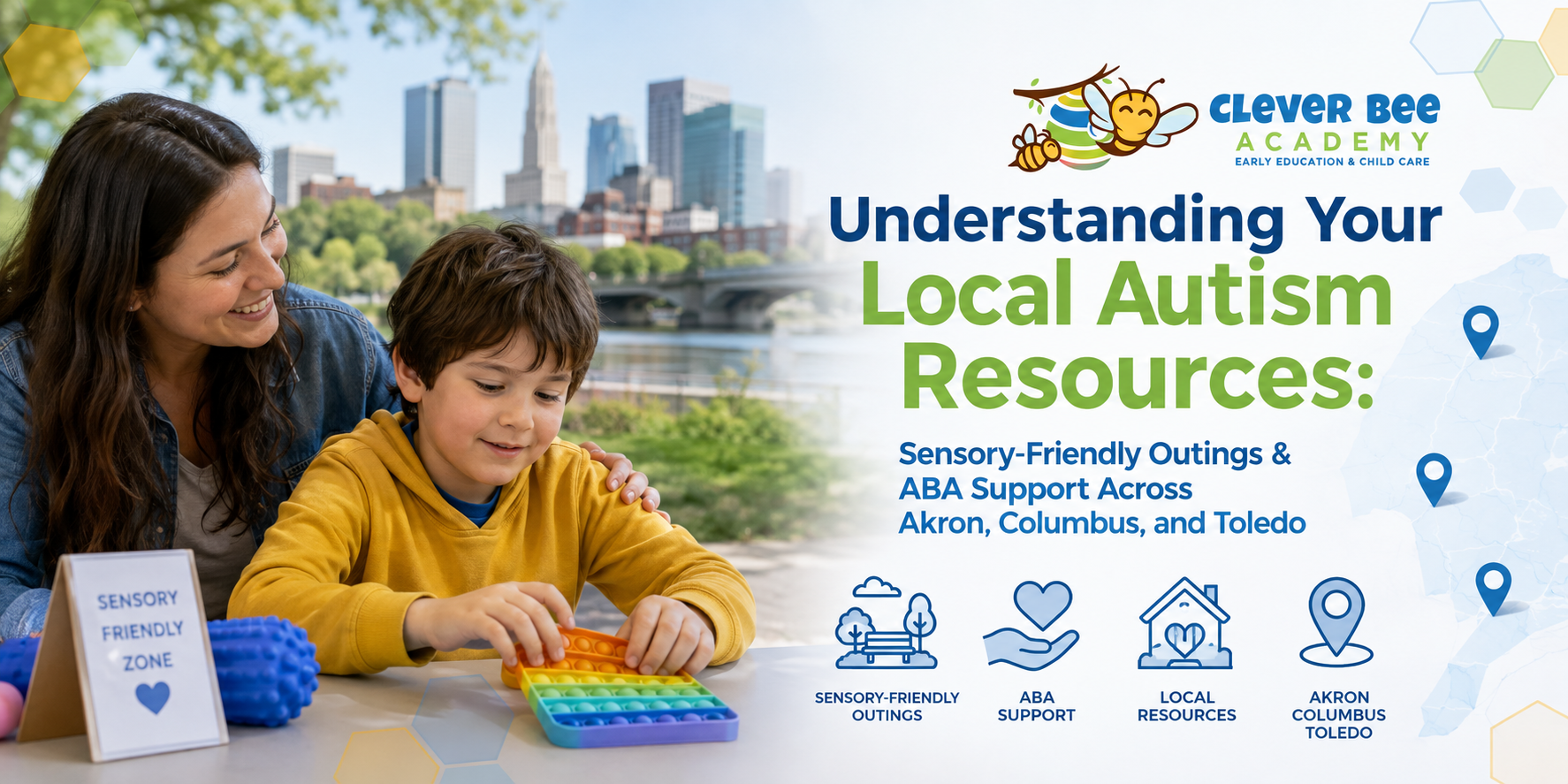
Two things determine whether a family outing goes well: how the venue is set up, and how prepared your child is to handle it. Ohio has quietly become one of the better states for the first half of that equation, with a statewide accessibility initiative, sensory bags and quiet rooms at major attractions, and low-sensory hours at museums, zoos, theaters, and the state fair. The second half is where therapy does its work: occupational therapy builds regulation strategies, and ABA builds the tolerance, communication, and transition skills that turn a chaotic afternoon into a manageable one. Below: what exists in Akron, Columbus, and Toledo, the planning steps that make outings work, and how to tell whether a venue’s accessibility claim is real.
Why identification and access vary so much by community
Before the destination list, one piece of context that explains a lot about why families in different Ohio cities have such different experiences. The CDC tracks autism identification across sixteen communities nationwide, and the spread between them is enormous.
Identified autism prevalence varies widely by community
8-year-olds, CDC ADDM Network sites, 2022 surveillance year
Source: Centers for Disease Control and Prevention, Facts About CDC’s ADDM Network: https://www.cdc.gov/autism/communication-resources/addm-network-factsheet.html
A fivefold difference between communities is not a biological finding. It reflects local screening practices, evaluation capacity, and how easily a family gets through the door. The same dynamic plays out inside Ohio, county to county, which is worth remembering when a parent in another city describes an experience nothing like yours.
Statewide: Accessible Ohio and sensory spaces
Autism support in Ohio is very clear: it runs a formal accessibility program through Opportunities for Ohioans with Disabilities. Its Accessible Ohio sensory spaces guidance is written for venues, but it is genuinely useful for parents because it tells you what a well-designed sensory space should contain: a defined quiet area, sensory tools available to borrow, clear signage, published information on an accessibility webpage, and a social narrative describing what visitors will experience. If a venue advertises a sensory room and cannot tell you where it is or what is in it, that tells you something.
The state applies the same standard to its own events. The Ohio State Fair, working with the Ohio Center for Autism and Low Incidence, the Ohio Department of Developmental Disabilities, and the Accessible Ohio program, now hosts an extended sensory-friendly day with reduced lights and volume on rides, alongside ASL interpretation and quiet programming. For a Columbus-area family, that single day can make an event that would otherwise be impossible into something the whole family attends together.
Akron and Summit County
Northeast Ohio families have good access to nature-based outings, which tend to be forgiving sensory environments: open space, few mid-week crowds, and easy exits. The Cuyahoga Valley corridor between Akron and Cleveland is the obvious anchor. Indoor venues in the region increasingly stock sensory bags, and several theaters run relaxed performances where movement and vocalizing are expected rather than merely tolerated.
For pulling together local supports, Kent State University maintains a practical directory of children and youth services across the Akron, Kent, and Portage County area, including autism-specific organizations, therapy providers, and volunteer connections. It is one of the few lists in the region that stays reasonably current.
On the therapy side, our Akron ABA therapy program works on the exact skills that outings demand: waiting, tolerating unpredictability, communicating a need to leave, and recovering from a disappointment without escalation. Those are teachable targets, and they are the difference between avoiding public places and gradually widening what your family can do.
Columbus and Franklin County
Central Ohio has the deepest bench of sensory-friendly programming in the state. Major science, art, and animal attractions have adopted sensory-inclusive certification, offering borrowable sensory bags, weighted lap pads, marked quiet zones, and early-access hours before general admission. Franklin County libraries run sensory storytimes with smaller groups and shorter sessions.
A practical Columbus tip: call ahead and ask for the venue’s social narrative, sometimes called a social story. It is a short visual guide showing what your child will see, hear, and do, in order. Reviewing it at home two or three times before you go does more for a successful visit than anything you can do once you arrive.
Toledo and Lucas County
Northwest Ohio’s zoo, museum, and metropark system have all added accessibility programming in recent years, and the region’s smaller crowds are an advantage rather than a limitation. Weekday mornings at almost any Toledo attraction are calmer than a Saturday in Columbus.
For clinical support, the Bowling Green State University Speech and Hearing Clinic, a short drive south of Toledo, is open to the public and treats infants, children, and adults, including social communication concerns associated with autism.
Sensory regulation itself is occupational therapy territory. Our occupational therapy program in Toledo works on sensory processing, fine motor skills, and daily living routines inside the preschool day, while our Toledo ABA therapy program handles the behavioral and communication side. Under one roof, the OT strategies that calm your child are the same ones the ABA team reinforces, which is how a regulation plan sticks.
A repeatable outing checklist
- Check the venue’s accessibility page before you go, and call to confirm what is currently available.
- Request the social narrative and review it at home more than once.
- Go at the quietest hour, usually a weekday morning or the first hour after opening.
- Identify the exit and the quiet space within two minutes of arriving.
- Bring your own regulation kit; borrowed sensory bags run out.
- Set a short target duration and leave on a good note rather than pushing to the breaking point.
- Debrief afterward with your therapy team so the next attempt targets what actually went wrong.
Frequently asked questions about Ohio Autism Resources in 2026
What is in a typical sensory bag?
Most include noise-reducing headphones in adult and child sizes, fidget tools, a communication card or whiteboard, and sometimes an identification wristband. Contents vary by venue, and supply is limited, so arrive early or bring your own.
How do I find sensory-friendly events near me?
Start with the venue’s own accessibility page, then check your county board of developmental disabilities and your public library system, which often publish shared community calendars. Regional autism societies also maintain event listings.
My child does fine at home but falls apart in public. Is that normal?
It is extremely common. Home is predictable and low-demand; public spaces are neither. This is a generalization issue, and it responds well to graded practice: short, planned outings that gradually increase in duration and complexity, with support from your therapy team.
Should we avoid outings until my child is ready?
Avoidance tends to shrink what a family can do over time. The better approach is smaller and shorter, not none. Ten successful minutes at a quiet museum builds toward an hour; a two-hour attempt that ends badly can set you back months.
Can ABA and occupational therapy be combined?
Yes, and for children with sensory sensitivities they usually should be. At Clever Bee Academy, ABA, occupational therapy, speech therapy, and trauma-informed support are coordinated within a single plan rather than delivered as unconnected appointments.