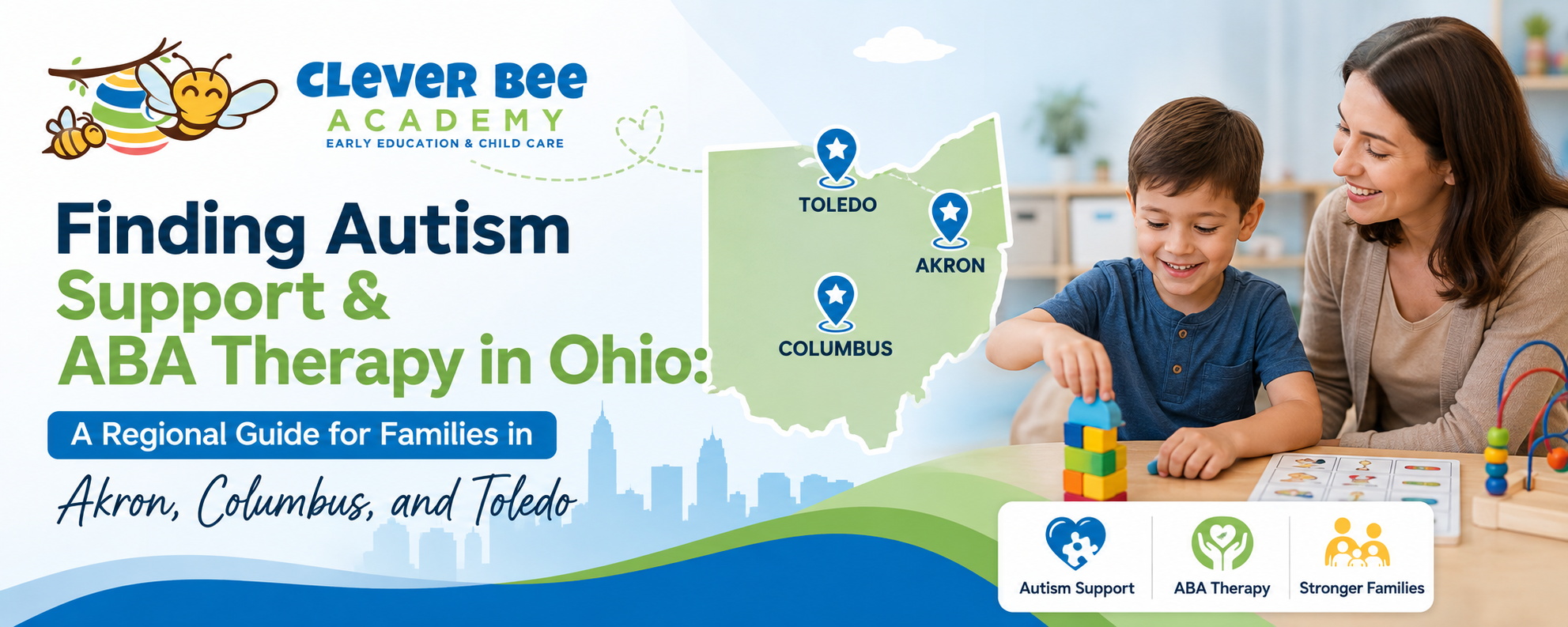
If you suspect your child is autistic or has already received a diagnosis, Ohio has three entry points worth knowing: Help Me Grow Early Intervention for children under three, your county board of developmental disabilities for ongoing supports, and a private ABA provider for direct therapy hours.
Waitlists for diagnostic evaluations in Akron, Columbus, and Toledo can stretch for months, so families get the best results when they start the referral process and the therapy search at the same time rather than one after the other. Center-based ABA that sits inside a licensed childcare setting solves a second problem most families run into: the need for therapy and the need for reliable full-day care rarely arrive separately. Below is a practical map of what exists in each region, what the data says about early identification, and the questions to ask before you sign anything.
Table of Contents
ToggleStart with the referral, not the waitlist
Most Ohio families first hear the phrase “developmental delay” from a pediatrician, a daycare teacher, or a relative who noticed something at a family gathering. The instinct is to wait for a formal autism diagnosis before doing anything else. That instinct costs time. Ohio’s Early Intervention system, delivered through Help Me Grow, does not require a diagnosis to begin. Any child under three with a suspected delay is eligible for a free evaluation, and anyone can make the referral, including a parent. You can start that process directly through the Ohio Department of Children and Youth’s Help Me Grow program.
Once your child turns three, the entry point shifts. Services move from Early Intervention to your local school district’s preschool special education team, and your county board of developmental disabilities becomes a long-term partner for supports that extend well past preschool. Every Ohio county has one, and each handles eligibility locally. The Ohio Department of Developmental Disabilities county board directory is the fastest way to find yours in Summit, Franklin, or Lucas County.
Why identification numbers keep climbing
Families often ask whether autism is genuinely more common now or whether clinicians are simply better at spotting it. The honest answer involves both broader diagnostic criteria and better screening, and the trend is steep either way. The CDC’s Autism and Developmental Disabilities Monitoring Network has tracked identified prevalence among eight-year-olds since 2000.
Identified autism prevalence among 8-year-olds, CDC ADDM Network
Rate per 1,000 children, by surveillance year
Source: Centers for Disease Control and Prevention, Data and Statistics on Autism Spectrum Disorder: https://www.cdc.gov/autism/data-research/index.html
The practical takeaway is not the headline number; it is what that number does to capacity. More identified children competing for the same pool of developmental pediatricians and behavior analysts means longer waits for everyone.
Akron and Summit County
Akron families sit close to a strong research and clinical corridor. Kent State University’s speech and hearing programs and its graduate autism coursework feed trained clinicians into the region, and the Autism Society of Greater Akron in Fairlawn is a long-standing peer support anchor. Summit County’s county board handles eligibility and service coordination for children who qualify.
For direct therapy, our ABA therapy program in Akron is built around children ages 6 weeks to 12 years, with one-on-one sessions and small-group work delivered inside a licensed childcare setting. That structure matters more than it sounds: your child practices requesting a turn, tolerating transitions, and sitting for circle time with actual peers, not in a therapy room isolated from ordinary daily routines.
Columbus and Franklin County
Central Ohio has the deepest concentration of academic and diagnostic resources in the state. The Ohio State University Nisonger Center, one of the first federally funded University Centers for Excellence in Developmental Disabilities, runs diagnostic clinics, behavior support services, and family programming, and partners closely with the Franklin County Board of Developmental Disabilities.
Depth does not always translate to speed, though. Diagnostic waits at large hospital systems are frequently the longest in the state. Families in Franklin County often use a two-track approach: hold the hospital evaluation slot while beginning services through a community provider. Our Columbus ABA therapy program coordinates behavior analysis alongside speech therapy, occupational therapy, and trauma-informed support so that the plan does not have to be rebuilt once a formal diagnosis lands.
Toledo and Lucas County
Northwest Ohio has fewer providers per capita than Columbus, which makes local university clinics genuinely useful. The University of Toledo Speech-Language-Hearing Clinic offers evaluation and treatment for communication and language concerns, including services provided at reduced or no cost through grant funding, and it screens preschool populations across the Toledo area.
Language delay is the single most common reason Toledo parents seek an evaluation, and it is also the area where ABA and speech therapy overlap most productively. Our Toledo ABA therapy program pairs the two rather than treating them as separate appointments on separate days at separate addresses.
Five questions to ask any ABA provider
- Who supervises the program, and how many hours per month does a Board Certified Behavior Analyst spend directly observing your child?
- What is the actual staff-to-child ratio during group time, not just during one-on-one sessions?
- How are goals written, measured, and reported back to you, and how often?
- Can speech therapy and occupational therapy be delivered in the same building on the same day?
- What happens at age five: does the provider coordinate with your school district’s IEP team?
Frequently asked questions
Does my child need an autism diagnosis before starting ABA therapy?
For insurance-funded ABA, yes, a diagnosis from a qualified licensed professional is generally required. For Early Intervention services in Ohio, no diagnosis is needed; a suspected delay is enough to trigger a free evaluation for children under three.
How long are diagnostic waitlists in Ohio?
They vary by region and by clinic, and they change constantly. Hospital-based developmental clinics in the largest metros generally carry the longest waits, while independent psychologists and university clinics sometimes have shorter ones. Ask to be placed on more than one list at a time.
Is ABA covered by insurance in Ohio?
Ohio law requires many health plans to cover ABA for autism, and Ohio Medicaid covers medically necessary applied behavior analysis for eligible children. Coverage details, prior authorization rules, and hour limits differ by plan, so verify benefits before services begin.
Can my child attend regular childcare while receiving ABA?
Yes. That is the premise of an integrated model. At Clever Bee Academy, therapeutic supports are scheduled around the childcare day so children stay in their classroom community instead of leaving it.
What if we live between two of these cities?
Families in Medina, Bowling Green, Delaware, and similar communities regularly commute to the nearest metro for services. Call the closest academy first; availability and start dates vary by location and by age group.