TL;DR
Behavioral support for a toddler is not punishment; it is the set of things adults change so a child can succeed: adjusting the environment, teaching a missing skill, and responding the same way every time. Most tantrums at this age are ordinary. Research on nearly 1,500 preschoolers found that while roughly 84% had a tantrum in the past month, fewer than 10% had one daily, and daily tantrums become less common as children move past age 3. What separates a typical tantrum from a concerning one is its pattern: when it happens, how long it lasts, and whether anyone gets hurt. Start with prevention, teach the replacement skill, and ask for a professional opinion if the pattern does not shift.
What “Behavioral Support” Actually Means
A two-year-old who throws a cup is not being manipulative. They are communicating with the tools they have, and at this age those tools are limited. Behavioral support starts from that premise: every behavior is doing a job for the child, usually getting something they want or escaping something they do not.
Practitioners organize the work into three moves that happen in order:
- Prevent. Change the setup so the hard moment is less likely. Feed the child before the grocery store. Give a two-minute warning before leaving the park.
- Teach. Give the child a skill that works better than the behavior: a word, a sign, a picture card, a way to ask for help.
- Respond. React the same way every time, so the child learns which path actually works.
Reading your child’s signals is the foundation of all three. Toddlers telegraph a great deal before they melt down, and even babies communicate through gaze long before words arrive, which is part of why parents wonder why babies stare. Harvard’s Center on the Developing Child calls this back-and-forth serve and return, and it is the single most protective thing an adult does in the toddler years.
What a Typical Tantrum Looks Like
A study of 1,490 preschoolers used a detailed parent questionnaire to map which tantrum features are ordinary and which ones are worth a closer look. The pattern was clear: common tantrums are predictable and tied to a trigger, while the less common features are unpredictable, destructive, or aggressive.
Chart: how often each tantrum feature was reported
Share of parents reporting the feature over one month, children ages 3 to 5
MORE TYPICAL
LESS TYPICAL
Source: Wakschlag et al., Multidimensional Assessment of Preschool Disruptive Behavior study, as summarized by the National Institute of Mental Health. NIMH summary.
The original paper, published in the Journal of Child Psychology and Psychiatry, reported that 83.7% of preschoolers had tantrums sometimes while only 8.6% had them daily. In other words, tantrums are close to universal, but frequent tantrums are not.
Frequency Drops as Children Get Older
A separate study of 861 children aged 1 to 5 tracked how often daily tantrums occur at each age. The answer is reassuring for parents of one- and two-year-olds and useful for everyone else: daily tantrums are roughly twice as common before age 3 as they are after.
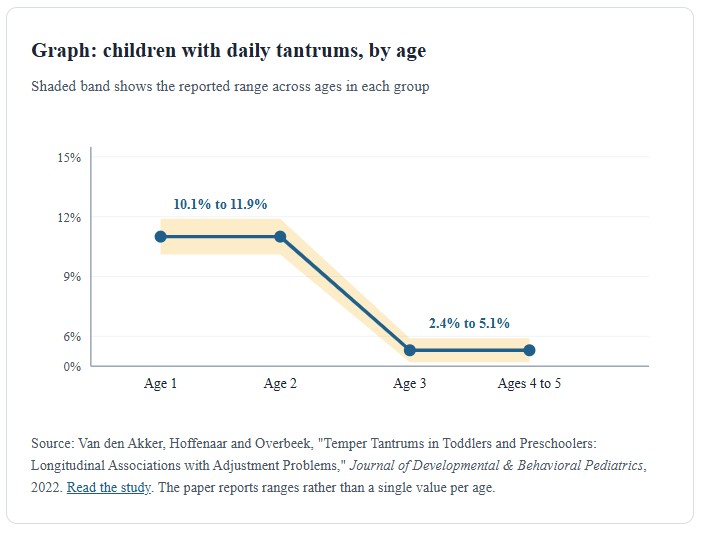
One wrinkle worth knowing: while tantrums get less frequent with age, the researchers found that they tend to get longer. Most tantrums for 1- to 3-year-olds ran one to five minutes, while most for 5-year-olds ran six to ten.
Six Supports That Do the Heavy Lifting
- Build a predictable day. Toddlers cannot tell time, but they can learn sequence. Meals, naps, and outings in the same order remove a large share of daily friction. Ohio State University Extension’s fact sheet on positive discipline makes the same point: a predictable environment helps children feel safe because they know what to expect.
- Say what to do, not what to stop. “Feet on the floor” gives a child an action. “Stop climbing” gives them nothing to replace it with. The Vanderbilt IRIS Center’s behavior module builds its entire approach for early childhood settings around positively stated expectations that are taught, not just posted.
- Teach a communication shortcut. Most toddler behavior that adults find difficult is a request in disguise. Teach “help,” “more,” “all done,” and “my turn” as words, signs, or pictures, then honor them immediately the first several dozen times.
- Offer two real choices. Red cup or blue cup. Boots first or coat first. Choice gives a toddler the control they are already reaching for, in a form that still gets everyone out the door.
- Stay boring during the storm. Once a tantrum is underway, teaching is off the table. Keep the child safe, keep your voice low, keep the rule intact, and save the conversation for afterward when the child can actually hear it.
- Spend the energy before it spends you. A toddler who has moved their body is a toddler with a longer fuse. Plan an outing most days, even in February, using local options like winter activities in Akron or these baby-friendly Cleveland outings.
Consistency Across Settings
A support plan only works if it follows the child. When home and the classroom use different words for the same rule, the toddler has to learn two systems at once. Tell your child’s teachers which phrases you use, ask what they use, and pick one set. Transitions are the moment this matters most, which is why it pays to walk through preparing a toddler for daycare before the first drop-off rather than after.
When to Ask for a Professional Opinion
Bring it up with your pediatrician when the pattern, not the volume, is the issue: tantrums that happen daily past age 3, episodes that regularly run past 15 minutes, aggression or self-injury that shows up often, behavior that appears out of the blue with no identifiable trigger, or a child who cannot settle afterward without a long recovery. Concerns about communication, play, or social connection deserve the same conversation. For families weighing structured behavioral services, this guide to ABA therapy for toddlers explains what assessment and treatment actually involve.
Frequently Asked Questions
Are daily tantrums normal for a two-year-old?
They are more common than most parents expect. Roughly 10% to 12% of 1- and 2-year-olds have daily tantrums, compared with about 2% to 5% of 3- to 5-year-olds. Daily tantrums are a clearer warning sign after age 3 than before it.
Does ignoring a tantrum work?
Planned ignoring works for behavior whose purpose is attention, and only when you stay consistent and reconnect warmly the moment the child calms. It is the wrong tool for behavior driven by escape, pain, or sensory overload, and it is never appropriate when a child is unsafe.
How long should it take to see progress?
Give a consistent plan two to four weeks before judging it, and expect behavior to briefly get worse first as the child tests whether the old approach still works. Track the count per day on a note in your phone, since memory tends to register the loudest day rather than the average one.
What if my toddler only melts down for me?
That is the ordinary pattern. In the research above, tantrums with a parent were reported far more often than tantrums with another adult. Children save their hardest moments for the people they feel safest with.
Support that carries through the whole day
Clever Bee Academy’s classrooms pair consistent routines and positive guidance with optional therapeutic inclusion services, so the approach your child meets at school matches the one at home. Start with the toddler ABA guide, or schedule a tour at the location nearest you.