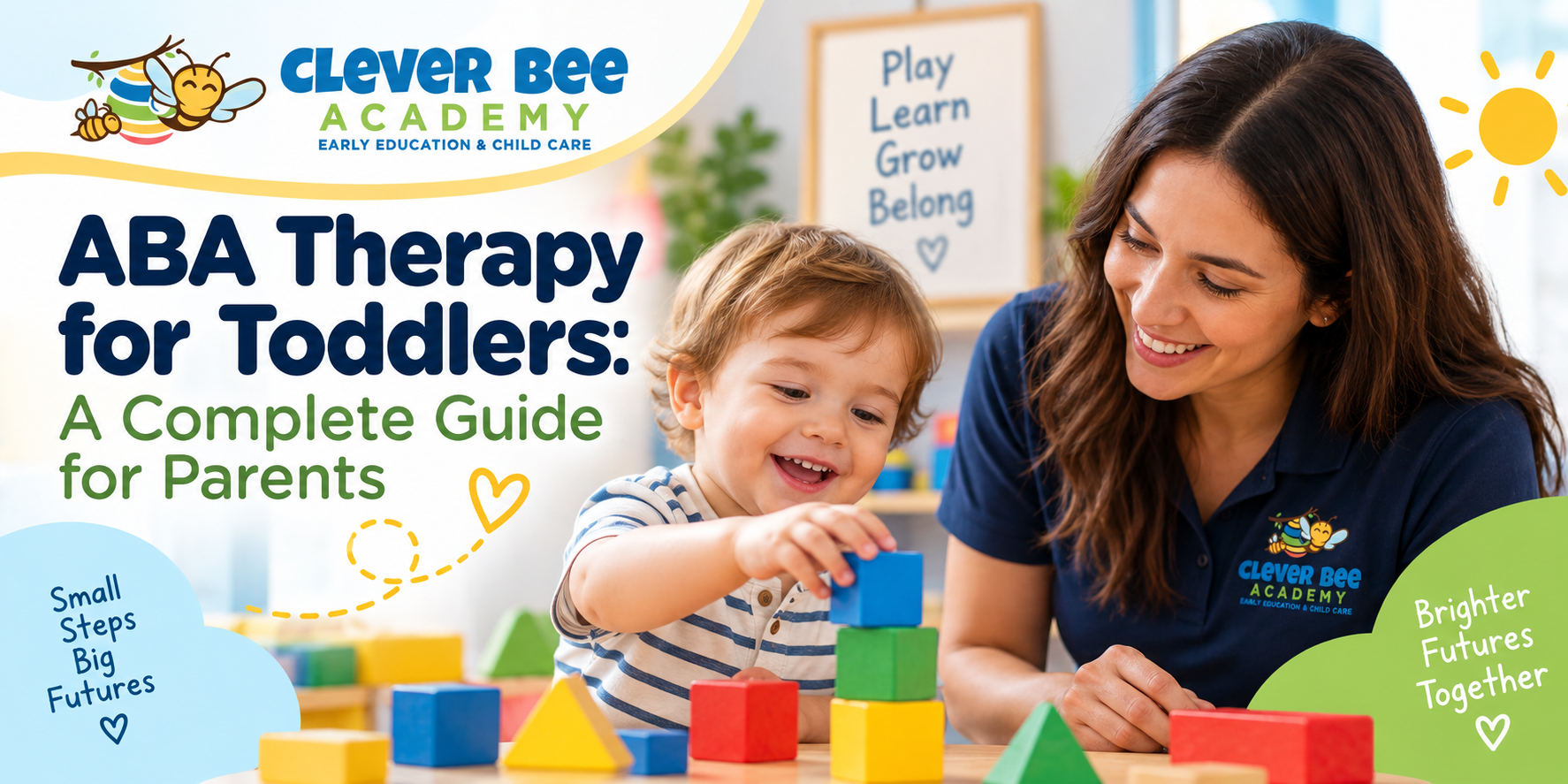
When a toddler is struggling with communication, social interaction, daily routines, or behaviors that make everyday life difficult, parents naturally want to know what they can do to help. The toddler years are a particularly important period of development because children are rapidly learning how to communicate, play, interact with other people, and become more independent.
For children with autism spectrum disorder (ASD) or developmental differences, Applied Behavior Analysis (ABA) therapy can be one approach used to support learning and development.
ABA is a behavioral approach that focuses on understanding how behaviors are learned and using evidence-based teaching strategies to help children develop useful skills. Modern ABA programs can address communication, play, social interaction, daily living, self-care, learning, independence, and other practical skills. The specific goals should always be individualized to the child rather than assuming that every toddler needs the same treatment.
Early intervention is important. The Centers for Disease Control and Prevention explains that early intervention services can help young children develop new skills and may have a significant impact on later success in school and life.
For families considering services, the most important question isn’t simply whether ABA is “good.” The better question is:
Can a thoughtfully designed, child-centered ABA program help this particular toddler develop skills that improve communication, independence, participation, and quality of life?
For many children, the answer may be yes.
This comprehensive guide explains what ABA therapy is, why it may be helpful for toddlers, what happens during treatment, which skills ABA can address, how parents participate, what to look for in a provider, and how families in Cleveland can begin exploring their options.
Table of Contents
ToggleWhat Is ABA Therapy?
Applied Behavior Analysis is an approach based on the science of learning and behavior.
At its simplest, ABA looks at:
- What happens before a behavior
- What the child does
- What happens immediately afterward
- What skills the child may be missing
- What motivates the child to learn
- How the environment can be changed to make learning easier
- How progress can be measured over time
The purpose isn’t simply to make a child “behave.”
A well-designed ABA program should help a child learn useful skills and participate more successfully in everyday life.
ABA can be used in different ways. Some programs use structured teaching, while others incorporate learning into play and natural daily activities.
Common ABA approaches include:
- Discrete Trial Training (DTT)
- Natural Environment Teaching (NET)
- Pivotal Response Training (PRT)
- Early Intensive Behavioral Intervention (EIBI)
- Positive Behavior Support (PBS)
- Functional communication training
- Parent-mediated behavioral strategies
These approaches aren’t necessarily competing treatments. A strong program may combine different strategies depending on what the toddler needs.
Why Are the Toddler Years So Important?
Toddlers are learning at an extraordinary pace.
Between roughly one and three years of age, children may rapidly develop:
- Vocabulary
- Gestures
- Imitation
- Joint attention
- Pretend play
- Social interaction
- Problem-solving
- Emotional regulation
- Self-feeding
- Dressing skills
- Toilet readiness
- Following directions
- Motor skills
- Independence
For children experiencing developmental delays, these skills may not emerge automatically or may develop differently.
That doesn’t mean the child can’t learn them.
It means that additional support may be useful.
The CDC recommends acting early when parents have concerns about development. Early intervention services are designed for babies and young children with developmental delays or disabilities, and eligibility is generally determined through an evaluation.
Parents looking for additional information about early childhood services can also explore Cleveland infant care resources.
Is ABA Only for Children With Autism?
No.
ABA is a science of behavior and learning, and behavioral principles can be applied to many populations and settings.
However, when parents search for “ABA therapy for toddlers,” they are often considering ABA because their child has autism, developmental delays, communication challenges, or behaviors that significantly interfere with everyday activities.
For autistic toddlers, ABA may be incorporated into a broader developmental treatment plan.
Importantly, ABA should not be viewed as a replacement for every other form of therapy.
A toddler may benefit from a combination of services, such as:
- ABA
- Speech-language therapy
- Occupational therapy
- Physical therapy
- Developmental therapy
- Parent coaching
- Early childhood education
- Other medically or educationally appropriate services
The right combination depends on the individual child.
What Does ABA Therapy for Toddlers Actually Look Like?
Many parents hear “ABA” and imagine a toddler sitting at a table answering endless questions.
That can be one teaching format, but it isn’t the only way ABA can be delivered.
For toddlers, effective intervention can involve:
- Playing with toys
- Looking at books
- Singing songs
- Practicing gestures
- Requesting snacks
- Getting dressed
- Washing hands
- Practicing transitions
- Playing alongside another child
- Practicing communication
- Learning safety skills
- Participating in family activities
The teaching environment can be highly structured, completely naturalistic, or somewhere between the two.
For example, imagine a toddler who wants a favorite toy but doesn’t yet communicate what they want.
Rather than simply handing over the toy every time, a therapist might create opportunities for the child to practice communicating. Depending on the child’s abilities, that communication might involve:
- Pointing
- Reaching
- Making a sound
- Using a word
- Using a sign
- Using a picture
- Using an AAC device
The therapist can reinforce the child’s communication attempt and gradually help the child develop more effective communication.
The objective isn’t perfection.
The objective is functional communication.
10 Major Benefits ABA May Provide for Toddlers
There isn’t one universal list of benefits that applies identically to every child. However, individualized ABA programs commonly target areas that can make a major difference in a toddler’s daily life.
1. Improved Communication
Communication is often one of the most important goals for families.
Some toddlers may have limited spoken language. Others may speak but struggle to use language functionally.
For example, a child might know several words but rarely use them to request, comment, answer questions, or interact with others.
ABA can break communication into teachable steps.
A program might work on:
- Requesting
- Labeling
- Answering questions
- Following directions
- Imitating sounds
- Using gestures
- Initiating communication
- Responding to communication
- Using AAC
- Expanding vocabulary
Functional communication can reduce frustration because children have more effective ways to express themselves.
Imagine a toddler who cries whenever they want juice because they don’t yet know how to communicate that request.
Teaching the child a reliable communication response can change the entire interaction.
Instead of:
Want juice → frustration → crying
the child can gradually learn:
Want juice → communicate → adult responds
That is a meaningful life skill.
2. Developing Social Skills
Social interaction is another common focus of early intervention.
A toddler may need support with skills such as:
- Responding to their name
- Looking toward a communication partner
- Taking turns
- Sharing attention
- Imitating another person
- Playing with another child
- Initiating interaction
- Responding to social bids
- Participating in group activities
These skills can be taught naturally through games and play.
For example, a therapist might roll a ball back and forth with a toddler.
The goal may initially be simply learning that another person is part of the game.
Over time, the child can learn:
- Wait for the ball.
- Receive the ball.
- Roll it back.
- Look toward the other person.
- Wait again.
- Initiate another turn.
A seemingly simple game can therefore become an opportunity to practice communication, imitation, joint attention, motor skills, waiting, and social reciprocity.
3. Building Independence
One of the most valuable outcomes of early intervention is increased independence.
Parents may seek help because their toddler requires significant assistance with everyday routines.
ABA can break complex activities into smaller steps.
For example, hand washing might involve:
- Walking to the sink
- Turning on the water
- Wetting hands
- Getting soap
- Rubbing hands together
- Rinsing
- Turning off the water
- Drying hands
A child doesn’t necessarily need to master every step immediately.
The therapist can identify which steps the child can already do and teach the remaining steps systematically.
Similar strategies can be applied to eating, drinking, dressing, brushing teeth, bathing, cleaning up toys, putting on shoes, washing hands, and toileting routines.
The long-term objective is not dependence on therapy.
It is greater independence outside therapy.
4. Reducing Frustration
Imagine not being able to tell someone:
- “I don’t want that.”
- “I need help.”
- “I want another snack.”
- “That hurts.”
- “I don’t understand.”
- “I want to leave.”
For a toddler who has difficulty communicating, frustration can sometimes emerge through behavior.
A child may cry, scream, throw objects, run away, or engage in other behaviors when they don’t have a more effective way to communicate.
ABA can examine why the behavior is happening and identify skills that can replace it.
This is often referred to as functional behavior assessment or functional analysis of behavior, depending on the circumstances and clinical approach.
The goal should not simply be:
“Stop the tantrum.”
Instead, the question should be:
“What is the child trying to communicate, obtain, avoid, or accomplish?”
Once that is understood, intervention can focus on teaching a safer and more effective way to accomplish the same legitimate need.
5. Learning to Follow Directions
Toddlers gradually learn how to respond to simple instructions.
Examples include:
- “Come here.”
- “Give me the ball.”
- “Sit down.”
- “Put it in.”
- “Bring your shoes.”
- “Clean up.”
- “Let’s go.”
For a toddler with developmental delays, these skills may require additional teaching.
ABA can break instructions into manageable steps and reinforce successful responses.
Following directions can be particularly important for safety.
6. Improving Play Skills
Play is not just entertainment.
For toddlers, play is one of the primary ways they learn.
Through play, children can practice:
- Imitation
- Communication
- Problem-solving
- Motor skills
- Social interaction
- Flexibility
- Attention
- Turn-taking
- Creativity
Some toddlers may engage in repetitive play or have difficulty using toys functionally.
A therapist may build on the child’s existing interests rather than forcing completely unrelated activities.
If a child loves cars, for example, cars can become the foundation for practicing turn-taking, requesting, imitation, joint attention, vocabulary, and pretend play.
7. Supporting School Readiness
Parents often wonder whether ABA can help prepare a toddler for preschool.
Potentially, yes.
School readiness involves much more than knowing letters and numbers.
A young child may need to learn how to:
- Sit for short activities
- Transition between activities
- Follow classroom routines
- Request help
- Wait briefly
- Participate in group activities
- Play near other children
- Follow simple instructions
- Clean up
- Handle changes in activities
- Communicate basic needs
ABA can target these functional skills.
8. Improving Flexibility
Some toddlers struggle significantly when routines change.
A small change—such as a different cup, a different route to daycare, or a different order of activities—can result in significant distress.
ABA can incorporate gradual practice with flexibility.
For example, a therapist might introduce very small changes to an established routine while helping the child tolerate the change.
Over time, the child may learn that:
Change does not always mean something bad is happening.
9. Teaching Safety Skills
Safety can be a particularly important consideration for some autistic toddlers.
Depending on the child’s needs, therapy may address:
- Responding to their name
- Stopping when instructed
- Staying near an adult
- Holding hands
- Waiting before crossing
- Following safety instructions
- Avoiding dangerous objects
- Asking for help
- Responding appropriately in public places
These skills should be individualized and taught in developmentally appropriate ways.
10. Helping Parents Understand Their Child’s Behavior
One of the most valuable aspects of behavioral intervention can be parent education.
Parents may become frustrated when they don’t understand why a particular behavior keeps happening.
ABA can provide a framework for looking at behavior objectively.
Instead of asking:
“Why is my child being difficult?”
parents can learn to ask:
“What happened before this behavior, what did my child do, and what happened afterward?”
That shift can be incredibly useful.
Why Early ABA May Be Especially Valuable
Early childhood is a period of rapid development.
The National Institute of Child Health and Human Development notes that early intervention may be particularly important because young children’s brains are still developing and adapting rapidly.
The CDC similarly emphasizes the importance of acting early when developmental concerns arise.
That does not mean that older children cannot benefit. They can.
It means that parents don’t necessarily need to wait for developmental difficulties to become severe before seeking help.
What Does the Research Say About ABA for Young Children?
Research on behavioral interventions for young autistic children has found potential benefits in areas such as adaptive behavior and cognitive development, although outcomes vary considerably between studies and children.
Research involving early intensive ABA-based interventions has reported improvements in areas including adaptive behavior and cognitive ability for some children, while also identifying substantial variation among studies.
Research examining interventions for toddlers with autism has also reported outcomes across areas including communication, general development, family well-being, imitation, joint attention, and play.
That distinction matters.
ABA isn’t a magic formula.
Children respond differently.
A treatment that works extremely well for one toddler may need to be modified for another.
The best programs therefore use ongoing measurement and adjust treatment based on the child’s progress.
ABA Should Be Individualized
Two toddlers with the same diagnosis may have completely different needs.
Toddler A
- Uses 20 words
- Wants to communicate
- Has difficulty with transitions
- Has strong play skills
- Struggles with following directions
Toddler B
- Uses few or no spoken words
- Has difficulty requesting
- Doesn’t consistently imitate
- Has limited functional play
- Becomes distressed during daily routines
Both children might receive an autism diagnosis.
But they should not automatically receive identical therapy.
Individualization is one of the most important characteristics parents should look for.
What Are Common ABA Goals for Toddlers?
A treatment plan might include goals in several categories.
Communication Goals
- Requesting preferred items
- Naming objects
- Using gestures
- Answering simple questions
- Following verbal instructions
- Communicating “no”
- Asking for help
- Expanding functional vocabulary
Social Goals
- Responding to others
- Initiating interaction
- Taking turns
- Imitating
- Participating in simple social games
- Sharing attention
Daily Living Goals
- Feeding
- Dressing
- Hand washing
- Tooth brushing
- Cleaning up
- Toileting routines
Behavioral Goals
- Developing functional communication
- Increasing tolerance for transitions
- Reducing dangerous behavior
- Learning replacement skills
- Improving emotional regulation
Learning Goals
- Matching
- Sorting
- Identifying objects
- Imitating actions
- Completing simple tasks
- Increasing attention to activities
How Does ABA Teach a New Skill?
A therapist may use a process sometimes called task analysis.
Task analysis means breaking a complicated skill into smaller steps.
Consider putting on shoes.
Instead of asking, “Put your shoes on,” the child may learn:
- Find the shoes.
- Pick up one shoe.
- Sit down.
- Put the foot near the opening.
- Put the foot inside.
- Pull the shoe into place.
- Repeat with the other foot.
The therapist can determine which steps the child already knows and teach the missing pieces.
Positive Reinforcement in ABA
Positive reinforcement is one of the core concepts associated with ABA.
In simple terms, when a behavior is followed by something meaningful to the child, that behavior may become more likely to occur again.
For toddlers, reinforcement might include:
- Praise
- A favorite toy
- A song
- Bubbles
- A game
- Access to a preferred activity
- A snack
- Social interaction
Importantly, reinforcement should be individualized.
Naturalistic ABA for Toddlers
Naturalistic approaches can be especially useful for young children because toddlers naturally learn through everyday activities.
Instead of creating an artificial learning environment for every skill, the therapist can use situations that naturally occur.
Snack Time
The child wants crackers. The therapist creates an opportunity to practice requesting.
Playtime
The child wants a toy car. The therapist practices communication and turn-taking.
Getting Dressed
The therapist works on following a routine.
Outdoor Play
The therapist practices safety and social interaction.
Story Time
The therapist practices attending, pointing, imitation, and communication.
Can ABA Be Fun for Toddlers?
It should be possible for therapy to include enjoyable activities.
Toddlers learn through play, movement, interaction, exploration, repetition, and social engagement.
A therapist may therefore incorporate:
- Music
- Books
- Bubbles
- Puzzles
- Blocks
- Cars
- Dolls
- Sensory activities
- Outdoor play
- Movement games
- Pretend play
A child’s interests are valuable information.
If a toddler is highly motivated by trains, for example, trains can become part of the teaching environment.
The Importance of Parent Participation
Parents aren’t simply spectators.
Parents know their child better than anyone.
They understand what motivates the child, what triggers frustration, what the child’s routines look like, what works at home, what doesn’t work, and which challenges affect the family most.
Parent participation can help therapy become more consistent across environments.
Generalization: Making Skills Work Outside Therapy
One of the biggest goals of effective therapy is generalization.
A child shouldn’t learn a skill only with one therapist in one room.
The skill should eventually become useful in everyday situations.
For example, suppose a toddler learns to request a toy from their therapist.
That’s useful.
But the ultimate goal is broader: the child should also be able to communicate with parents, grandparents, teachers, siblings, other caregivers, and people in the community.
ABA and Speech Therapy: What’s the Difference?
ABA and speech-language therapy can overlap, but they aren’t identical.
A speech-language pathologist focuses on communication and related areas such as speech, language, receptive language, expressive language, pragmatic communication, and feeding and swallowing when appropriately trained.
ABA can also address communication from a behavioral learning perspective.
These professionals can work together.
ABA and Occupational Therapy
Occupational therapy can address areas such as:
- Fine motor skills
- Sensory processing
- Self-care
- Feeding
- Coordination
- Daily living skills
- Functional participation
ABA may also address daily living skills and behaviors.
Again, the therapies don’t necessarily need to compete. A coordinated team can help ensure that goals are complementary.
What Is Early Intensive Behavioral Intervention?
Early Intensive Behavioral Intervention, or EIBI, is one form of behavioral intervention designed for young children with autism.
The intensity of services should always be determined based on the individual child’s needs, family circumstances, goals, and clinical recommendations.
More therapy is not automatically better.
Quality matters. The child’s experience matters. Family sustainability matters. And goals matter.
How Many Hours of ABA Does a Toddler Need?
There is no single number of hours that is right for every toddler.
A treatment recommendation should be based on:
- The child’s developmental profile
- Current skills
- Treatment goals
- Behavior challenges
- Communication needs
- Family priorities
- School or daycare schedule
- Other therapies
- The child’s ability to participate
- Progress over time
Parents should be cautious about providers who appear to recommend an arbitrary number of hours without first understanding the child.
What Happens During an ABA Assessment?
Before developing a treatment plan, a provider typically needs to understand the child’s current abilities and challenges.
Assessment may include:
- Parent interviews
- Direct observation
- Developmental assessments
- Skill assessments
- Behavior assessment
- Communication assessment
- Review of medical or developmental history
- Observation in different environments
The provider should identify strengths as well as challenges.
A toddler isn’t simply a list of deficits.
What Does High-Quality ABA Look Like?
Quality ABA should be:
- Individualized: The program should be designed around the child.
- Measurable: Progress should be tracked.
- Functional: Goals should matter in real life.
- Family-centered: Parents should have a meaningful voice.
- Developmentally appropriate: Expectations should fit the child’s developmental level.
- Strength-based: The child’s abilities and interests should be incorporated.
- Flexible: Treatment should change when the data show that something isn’t working.
- Respectful: The child’s dignity, communication, preferences, and well-being should remain central.
A Child-Centered Approach to ABA
The modern conversation around ABA increasingly includes questions about quality, ethics, autonomy, and the individual experience of autistic children.
The purpose of therapy should not be to make a child appear indistinguishable from every other child.
The purpose should be to help the child develop useful skills and have greater access to communication, relationships, education, independence, and meaningful activities.
For example, there is an important distinction between teaching a child to communicate discomfort and teaching a child never to express discomfort.
Likewise, there is a distinction between teaching a child to remain safe near a caregiver and trying to eliminate every form of repetitive behavior simply because it looks different.
Parents should ask providers how they distinguish between behaviors that genuinely interfere with safety or functioning and harmless differences in behavior.
Is ABA Therapy Safe for Toddlers?
ABA itself is not a single standardized experience.
The quality and philosophy of a program matter.
Parents should therefore evaluate the specific provider, treatment plan, goals, methods, and supervision.
Important questions include:
- Are interventions age appropriate?
- Are goals meaningful?
- Does the child have opportunities to play?
- Are communication attempts respected?
- Is reinforcement used appropriately?
- Are parents involved?
- Is progress monitored?
- Are interventions adjusted when necessary?
- Does the child appear comfortable and engaged?
- Are harmful practices avoided?
What About Tantrums During ABA?
Tantrums can occur for many reasons.
A toddler might be tired, hungry, overstimulated, frustrated, confused, unable to communicate, asked to stop a preferred activity, asked to do something difficult, or experiencing sensory discomfort.
ABA should not simply interpret every tantrum as “bad behavior.”
Instead, therapists can investigate the circumstances surrounding the behavior.
For example:
Before: Child is asked to transition away from a favorite toy.
Behavior: Child cries and drops to the floor.
After: Transition is delayed.
This pattern may suggest that the behavior is related to escaping or delaying the transition.
Treatment might then involve teaching a transition routine, providing advance warnings, teaching an appropriate way to request more time, reinforcing successful transitions, and gradually increasing tolerance.
ABA and Emotional Regulation
Toddlers are still learning how to regulate emotions. This is true for autistic and non-autistic children alike.
ABA may support regulation indirectly by teaching:
- Functional communication
- Waiting
- Requesting help
- Asking for a break
- Tolerating small changes
- Following predictable routines
- Using replacement behaviors
Other therapies may also be appropriate for emotional regulation.
How ABA Can Help With Daily Routines
Predictable routines can be extremely useful for toddlers.
ABA can help children learn routines such as:
Morning Routine
Wake up → get dressed → brush teeth → eat breakfast → put on shoes.
Bedtime Routine
Bath → pajamas → brush teeth → story → bed.
Mealtime Routine
Sit → eat → request more → communicate “all done” → clean up.
Leaving the House
Shoes → coat → bag → door → car.
Breaking routines into steps can make them easier to learn.
ABA and Daycare
Many toddlers spend significant portions of their day in daycare or preschool.
That makes coordination particularly valuable.
A child may learn a skill in therapy but struggle to use it in daycare.
Providers can potentially collaborate around:
- Communication systems
- Visual supports
- Transition routines
- Reinforcement strategies
- Safety skills
- Social interaction
- Classroom expectations
ABA in the Home
Home-based intervention can have several advantages.
The therapist can observe the child in the environment where many real-life challenges occur.
Examples include:
- Mealtime
- Bath time
- Bedtime
- Getting dressed
- Playing with siblings
- Cleaning up
- Leaving the house
This can make treatment highly functional.
ABA in a Center
Center-based programs can provide access to:
- Structured learning environments
- Multiple therapists
- Other children
- Group activities
- Specialized materials
- Consistent routines
Center-based therapy may also create opportunities to practice social skills with peers.
Neither setting is automatically better. The right environment depends on the child and goals.
How Long Does ABA Therapy Last?
Treatment duration varies widely.
Some children receive intensive intervention for multiple years. Others may need targeted support for a shorter period.
The objective should be progress toward meaningful goals—not simply continuing therapy indefinitely.
As children develop new skills, treatment plans can change.
How Can Parents Tell Whether ABA Is Working?
Progress should be visible in meaningful areas.
Parents can look for changes such as:
- More communication
- Fewer dangerous behaviors
- Greater independence
- Better transitions
- More functional play
- Increased social interaction
- Improved ability to follow routines
- Greater participation at home
- Better participation at daycare or preschool
Data can also provide more objective information.
What If Progress Is Slow?
Slow progress doesn’t necessarily mean therapy isn’t working.
But slow progress should prompt questions.
The team may need to reconsider:
- The goal
- The teaching strategy
- The reinforcement
- The difficulty level
- The child’s motivation
- The environment
- The number of practice opportunities
What If My Toddler Hates ABA Therapy?
This is something parents should take seriously.
Toddlers can resist activities for many ordinary reasons, but persistent distress deserves attention.
Parents should ask:
- What specifically is causing distress?
- Is the activity too difficult?
- Is the environment overwhelming?
- Are there too many demands?
- Is the child communicating a legitimate need?
- Can the teaching strategy be modified?
- Are there enough opportunities for play and choice?
Choosing an ABA Provider in Cleveland
For Cleveland-area families, finding the right early-childhood and behavioral support can be an important part of navigating the toddler years.
Parents may want to look for providers that offer an individualized approach, communicate clearly with families, and understand the unique needs of very young children.
- Families specifically researching local behavioral services can learn more about Cleveland ABA therapy.
- Families exploring broader early-childhood services can also learn more about Cleveland infant care.
When comparing providers, remember that the best choice isn’t necessarily the provider offering the most hours or the most services.
The better question is: Which provider is most likely to understand my child and help my child develop meaningful skills?
Questions to Ask During an ABA Consultation
About Treatment
- How do you assess my child?
- How are treatment goals selected?
- How often are goals reviewed?
- How do you measure progress?
About Therapists
- Who will work directly with my child?
- Who supervises the program?
- How frequently does clinical supervision occur?
- How are therapists trained?
About Parents
- How will you involve me?
- Do you provide parent training?
- How do you communicate progress?
About Challenging Behavior
- How do you determine why a behavior occurs?
- How do you teach replacement behaviors?
- What happens if my child refuses an activity?
About Communication
- Do you work with speech-language pathologists?
- Do you support AAC?
- How do you encourage functional communication?
About the Child’s Experience
- How do you incorporate play?
- How do you incorporate my child’s interests?
- How do you provide choices?
- How do you protect my child’s dignity?
How Parents Can Support ABA Therapy at Home
Parents don’t need to become therapists.
But small changes can create more opportunities for learning.
Give Opportunities to Communicate
Instead of immediately giving a desired item, create natural opportunities for your child to communicate.
For example, if your child wants bubbles, pause and wait for a communication attempt.
That attempt could be pointing, looking, gesturing, vocalizing, signing, using a picture, or saying “bubbles.”
Then respond positively.
Practice Skills During Ordinary Routines
Therapy doesn’t have to stop when the therapist leaves.
You can practice requesting during meals, following directions during cleanup, naming objects during books, turn-taking during games, and independence during dressing.
Don’t Turn the Whole Day Into Therapy
This is important.
Parents should not feel that every interaction needs to become a lesson.
Children need:
- Rest
- Free play
- Family time
- Affection
- Exploration
- Quiet
- Unstructured activities
Therapy is only one part of childhood.
The ultimate objective is for the child to have a meaningful life—not to spend childhood completing an endless list of therapeutic exercises.
The Role of Play in Toddler ABA
Play should be taken seriously.
A child who learns to play functionally gains opportunities to develop multiple skills simultaneously.
Consider a simple pretend tea party.
A child can practice:
- Imitation
- Pretend play
- Requesting
- Turn-taking
- Joint attention
- Vocabulary
- Motor skills
- Social interaction
That’s why child-led and naturalistic approaches can be especially useful for young children.
ABA and Parent-Child Relationships
Parents sometimes worry that therapy will interfere with their relationship with their child.
A thoughtfully designed program should aim for the opposite.
Parents can learn strategies that make interactions easier.
If a child frequently becomes frustrated because they cannot communicate, improving communication may create more positive interactions.
If transitions constantly lead to conflict, teaching predictable transition skills may make family routines calmer.
If a child cannot participate in simple play, teaching play skills can create more opportunities for shared enjoyment.
The goal should be to support the relationship—not replace it.
Early Intervention Does Not Mean Something Is “Wrong” With Your Child
Seeking therapy can sometimes feel emotionally difficult for parents.
Some parents worry that beginning services means they are labeling their child.
It is important to remember that early intervention is about providing support.
Getting an evaluation does not commit a family to one particular therapy. It simply provides more information, allowing a family to make an informed decision.
Developmental Screening Matters
Parents should pay attention to how their child is progressing across multiple areas, including communication, social interaction, play, movement, learning, emotional development, and daily living.
A single missed milestone does not automatically mean a child has autism or another developmental condition.
But persistent concerns are worth discussing with a pediatrician or qualified developmental professional.
Resources for Parents
- Parents can learn more about early intervention through the CDC early intervention resources, which provide information about services for young children with developmental concerns.
- The NICHD early intervention information also provides background on early intervention and autism.
- Parents interested in research can review research from the University of Missouri–St. Louis on interventions for toddlers with autism.
- Additional research is available through Mount Sinai researchers studying early ABA-based interventions.
How to Think About ABA as a Parent
A helpful way to think about ABA is:
ABA isn’t about changing who your child is.
It’s about identifying skills that could make your child’s life easier and giving them systematic opportunities to learn those skills.
If your toddler can’t communicate what they want, communication is a useful target.
If they can’t safely follow basic instructions, safety skills are useful.
If everyday routines cause overwhelming difficulty, adaptive skills may be useful.
If they struggle to play with others, social interaction may be useful.
If they need significant help with daily living activities, independence may be useful.
The specific targets should come from the child.
A Practical ABA Toddler Goal-Setting Example for Parents
Imagine a toddler who frequently cries when they want a snack.
Instead of writing the vague goal:
“Reduce crying.”
A stronger functional goal might be:
“Increase independent functional requests for preferred snacks using the child’s individualized communication system.”
That goal is better because it identifies the skill that should replace the challenging behavior.
Another example:
Instead of:
“Improve behavior during transitions.”
A more functional goal might be:
“Increase the child’s ability to transition from a preferred activity to a scheduled activity using a visual or verbal transition cue.”
The difference is important.
The goal isn’t merely suppressing behavior.
The goal is teaching a useful skill.
The Long-Term Goal of ABA for Toddlers
Ultimately, therapy should work toward increasing a child’s ability to participate in life.
That can include:
- Communicating
- Learning
- Playing
- Building relationships
- Participating in school
- Developing independence
- Staying safe
- Making choices
- Expressing preferences
- Participating in family routines
- Accessing the community
Therapy should ideally become a bridge toward greater independence—not a permanent substitute for everyday life.
Starting ABA Therapy: A Step-by-Step Guide
Step 1: Write Down Your Concerns
Don’t just write “My child seems delayed.”
Be specific. For example:
- Doesn’t use words to request things
- Rarely responds to name
- Becomes extremely upset during transitions
- Doesn’t engage in functional play
- Needs significant help with dressing
- Runs away in public
- Has difficulty communicating needs
Step 2: Talk to Your Pediatrician
Discuss developmental concerns and ask whether additional screening or evaluation is appropriate.
Step 3: Explore Early Intervention
For children under three, investigate your state’s early intervention system and available services.
Step 4: Research Providers
Compare several providers when possible.
Step 5: Schedule Consultations
Ask detailed questions about treatment philosophy, staffing, supervision, parent involvement, and progress measurement.
Step 6: Understand the Treatment Plan
Make sure you know what goals are being addressed, why those goals were selected, how progress will be measured, and how parents participate.
Step 7: Reassess Regularly
Treatment should evolve as the child develops.
ABA Therapy for Toddlers in Cleveland
- For Cleveland-area families, finding the right early-childhood and behavioral support can be an important part of navigating the toddler years.
- Parents may want to look for providers that offer an individualized approach, communicate clearly with families, and understand the unique needs of very young children.
- Families specifically researching behavioral services can learn more about Cleveland ABA therapy.
- Families exploring broader early-childhood services can also learn more about Cleveland infant care.
- When comparing providers, remember that the best choice isn’t necessarily the provider offering the most hours or the most services.
- Families can explore Cleveland ABA therapy and broader early-childhood services through Cleveland infant care.
Final Thoughts: Why Consider ABA Therapy for a Toddler?
The toddler years are a period of extraordinary learning. For children who are developing typically, many skills emerge naturally through everyday experiences.
For children with autism or developmental delays, some of those skills may require more intentional teaching.
That is where early intervention can make a difference.
ABA provides a structured way to understand behavior, teach skills, measure progress, and adapt intervention based on what the child is actually learning.
10 Potential areas of benefit include:
- Communication
- Social interaction
- Play
- Independence
- Daily living skills
- Following directions
- Flexibility
- Safety
- School readiness
- Functional behavior
The most important point for parents is that ABA should be viewed as a tool, not a one-size-fits-all solution.
A good program starts with the child. It identifies meaningful goals. It respects communication. It incorporates the child’s interests. It involves parents. It measures progress. And it adjusts when something isn’t working.
For a toddler who is struggling to communicate, participate, play, learn, or become independent, the right intervention can create opportunities that might otherwise be much harder to access.
Early support doesn’t mean expecting a toddler to grow up faster. It means giving that toddler additional tools to learn, communicate, participate, and thrive!