
Navigating the cost of early education is one of the most challenging financial hurdles for working parents in Ohio. With annual tuition often rivaling mortgage payments or in-state college tuition, finding reliable, high-quality care without breaking the bank can feel overwhelming.
Fortunately, state-sponsored assistance programs, federal tax benefits, and flexible provider payment structures offer significant financial relief. Below is a comprehensive guide breaking down what childcare actually costs across the state, how Ohio’s Publicly Funded Child Care (PFCC) program works, and practical payment options to help bring quality care within reach.
Understanding Ohio Childcare Assistance and Payment Options for Working Families
For most working parents in Ohio, childcare is one of the largest lines in the family budget, often rivaling rent or a mortgage payment. The good news is that families do not have to shoulder that cost alone. Between state assistance programs, tax benefits, and providers who accept a range of payment methods, there are real ways to make quality care affordable. This guide walks through what care actually costs in Ohio, the main assistance program working families rely on, and the payment options worth knowing before you enroll.
What Childcare Really Costs in Ohio
Prices vary by a child’s age and the type of setting, but the pattern is consistent: infant care costs the most because it requires the highest staff-to-child ratios, and center-based care generally costs more than home-based care. The chart below shows the average annual price across the three main age groups.

Source: Policy Matters Ohio, “Ohio’s childcare crisis, 2025,” policymattersohio.org
The dashed line tells the real story. The U.S. Department of Health and Human Services considers childcare affordable when it costs 7 percent or less of household income, which works out to roughly $4,880 a year for a typical Ohio household. Every bar sits well above that line, which is exactly why assistance and smart payment planning matter so much for working families. Costs also climb in urban areas like Columbus, Cleveland, and Cincinnati, where demand is highest, so a family paying for two children under five can easily face a bill larger than a year of in-state college tuition.
Ohio’s Main Assistance Program: Publicly Funded Child Care
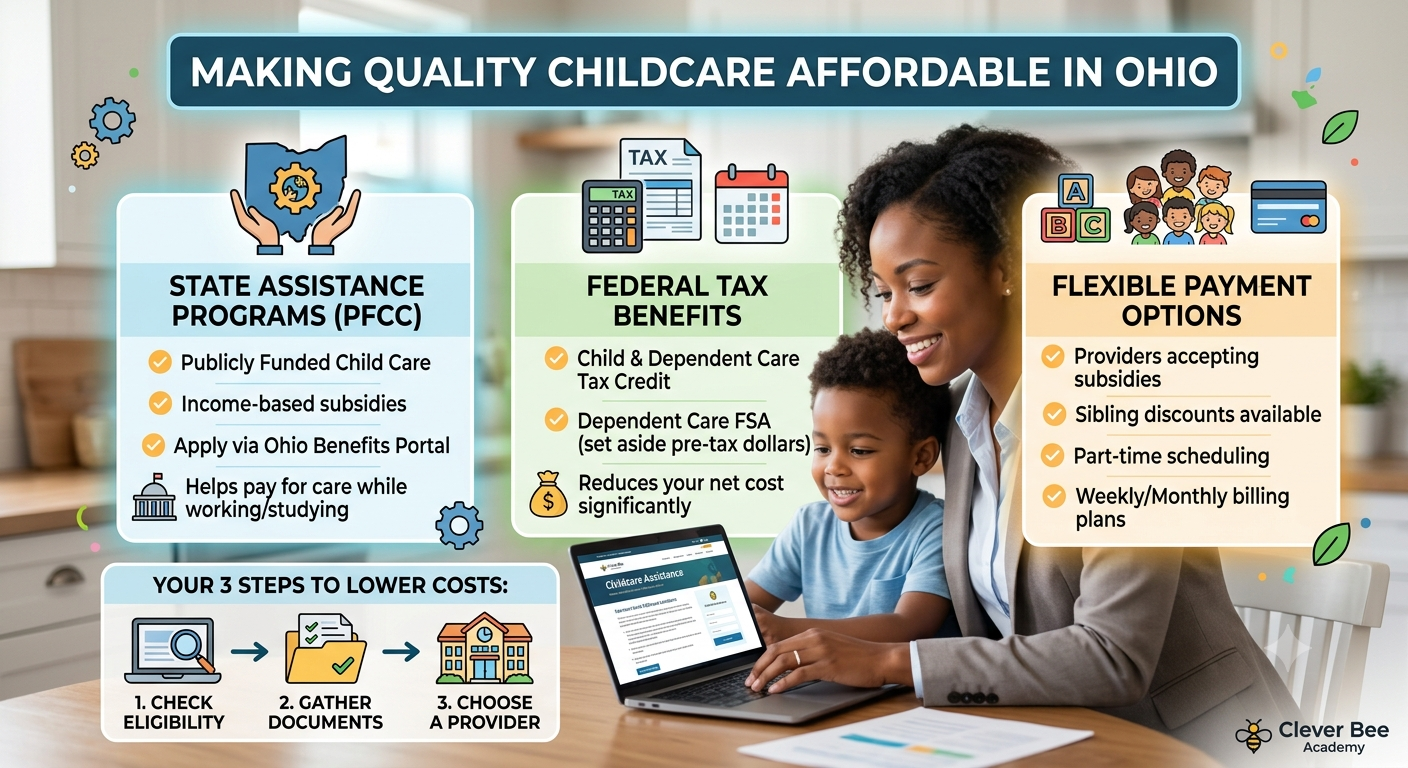
The centerpiece of childcare help in Ohio is Publicly Funded Child Care (PFCC), administered by the Ohio Department of Children and Youth and processed through your county Department of Job and Family Services. The program helps eligible parents pay for care while they work, attend school, or take part in job training. You can read the official overview of how it works on the state’s Department of Children and Youth childcare page.
Eligibility is based on household income relative to the federal poverty level, along with a work, school, or training requirement, and the child generally must be under age 13. Ohio has been steadily widening access, and a federally driven change taking effect in 2026 caps family copayments at 7 percent of household income, the same affordability benchmark shown in the chart. Because thresholds are adjusted periodically, it is always worth checking the current numbers rather than relying on older figures.
How to Apply and Other Payment Options
Applying is more straightforward than many parents expect. The fastest route is online through the Ohio Benefits portal, and the state’s Early Care and Education assistance page lays out the programs, an eligibility self-assessment tool, and the documents you will need, typically proof of income, residency, your child’s birth certificate, and verification of work or school hours. Approvals often move quickly, and in many cases a child can begin attending while the application is still under review.
Assistance is not the only lever. Federal tax benefits can meaningfully lower your net cost: the Child and Dependent Care Tax Credit covers a percentage of qualifying expenses, and a Dependent Care Flexible Spending Account lets you set aside up to $5,000 in pre-tax dollars if your employer offers one. Many families combine these tools with a subsidy or a provider’s own payment plan to bring monthly costs down to something manageable. It is also worth asking centers about part-time schedules, sibling discounts, and weekly rather than monthly billing, since small structural changes can add up to real savings over a year.
What the Research Says About Affordability
The strain on working families is well documented. Analysis from the University of New Hampshire’s Carsey School of Public Policy shows that lower-income working families who pay for care are far more likely to spend well above the 7 percent affordability threshold, which is why subsidies can be the difference between a parent staying in the workforce or leaving it. Policy researchers at Brookings have found that sliding-scale caps on childcare costs would allow more than a million additional parents nationwide to join the labor force, with the largest gains for mothers. Ohio’s copay cap moves in that same direction.
Finding Affordable, Quality Care
Cost matters, but so does finding a program that supports your child’s growth and works with your budget. Providers that participate in assistance programs and accept multiple forms of payment make the math far easier for working families. Clever Bee Academy, for example, runs several affordable daycare centers across Columbus built around exactly this need, with locations like the Northern Lights center on Cleveland Avenue serving nearby neighborhoods. Many of our centers, including the Livingston Avenue location, accept various forms of payment including government assistance programs, so a subsidy can be applied directly toward tuition.
The bottom line for Ohio parents is encouraging: childcare is expensive, but a mix of Publicly Funded Child Care, tax benefits, and flexible provider payment options can close much of the gap. Start by checking your eligibility on the Ohio Benefits portal, gather your documents, and talk with prospective providers about which payment methods they accept. With the right combination in place, quality care becomes far more attainable than the sticker price alone suggests.
Frequently Asked Questions (FAQ) about Ohio Childcare Assistance in 2026
Q: What is Publicly Funded Child Care (PFCC) in Ohio, and who is eligible?
A: Publicly Funded Child Care (PFCC) is a state subsidy program administered by the Ohio Department of Children and Youth through county Departments of Job and Family Services. It helps pay for childcare while parents work, attend school, or participate in job training. Eligibility is based on household income relative to the Federal Poverty Level (FPL) for children under age 13 (or up to age 18 for children with verified special needs). Once enrolled, families can retain subsidy support as their income rises, up to 300% FPL.
Q: How much will my family have to pay out-of-pocket with Ohio childcare assistance?
A: Family copayments for Publicly Funded Child Care are capped at 7% of household income. This copay limit aligns directly with the federal affordability standard established by the U.S. Department of Health and Human Services, preventing working families from taking on unsustainable childcare debt.
Q: How do I apply for Ohio childcare assistance, and what documents are required?
A: The fastest way to apply is online via the Ohio Benefits portal (ssp.benefits.ohio.gov) or by submitting paper application forms directly to your county Department of Job and Family Services office. You will typically need to provide proof of income (such as recent pay stubs), proof of residency, your child’s birth certificate, and official verification of your work or school schedule.
Q: Can my child start attending daycare while our PFCC application is still pending?
A: Yes. In many cases, participating centers allow children to begin attending while the county processes the paperwork under conditional enrollment policies. Be sure to confirm intake rules directly with your preferred center before enrolling.
Q: Can I combine state childcare subsidies with federal tax benefits or provider discounts?
A: Yes. You can stack multiple financial tools to minimize out-of-pocket expenses. Parents can claim the federal Child and Dependent Care Tax Credit or utilize an employer-sponsored Dependent Care Flexible Spending Account (FSA) (which allows setting aside up to $5,000 in pre-tax dollars). Furthermore, many learning academies offer sibling discounts, part-time rate structures, and weekly payment options that integrate directly with government assistance.