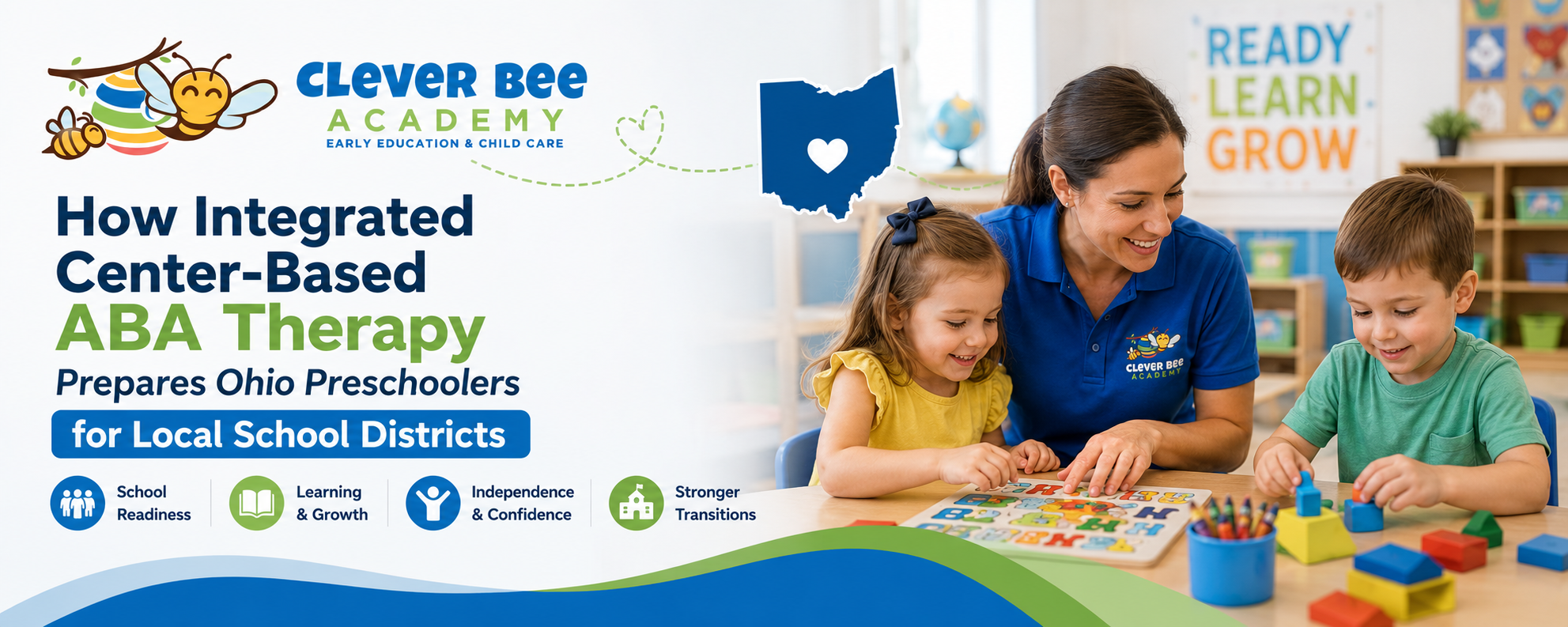
Ohio measures every incoming kindergartner with the Kindergarten Readiness Assessment, and the results for children with disabilities are sobering: the overwhelming majority do not demonstrate readiness on entry. The gap is rarely about intelligence. It is about the specific behaviors school asks for on day one: sitting in a group, following a two-step direction from an unfamiliar adult, transitioning without a meltdown, and asking for help with words or a device.
Center-based ABA delivered inside a real preschool classroom teaches those behaviors where they will actually be used, which is why generalization holds up better than with clinic-only or home-only models.
Below: what Ohio districts expect at kindergarten entry, how an integrated model builds toward it, how the preschool-to-kindergarten IEP transition works, and where the Autism Scholarship fits.
Table of Contents
ToggleWhat “school readiness” actually means in Ohio
Ohio’s Kindergarten Readiness Assessment scores children across social foundations, language and literacy, mathematics, and physical well-being and motor development. Teachers administer it through observation and short tasks during the first weeks of school. Children land in one of three bands: emerging, approaching, or demonstrating readiness.
Notice what dominates that list. Social foundations, covering self-regulation, attention, and approaches toward learning, is exactly the domain where a well-run ABA program does its most visible work. A child who can label twenty animals but cannot tolerate the move from free play to circle time will struggle in a room of twenty-four peers and one teacher.
Ohio kindergartners “demonstrating readiness” on the KRA
2022–2023 statewide results, by student group
Source: Groundwork Ohio analysis of Ohio Kindergarten Readiness Assessment data: https://www.groundworkohio.org/post/kindergarten-assessment-predicts-children-s-success-through-education
Research out of Ohio State has found that KRA performance predicts later academic outcomes, including third-grade reading. Work from Ohio State’s Crane Center for Early Childhood Research and Policy covers kindergarten transition, school readiness, and autism and learning disabilities, and it consistently points in the same direction: the skills a child brings through the door on the first day of kindergarten shape the trajectory that follows. That is an argument for treating the preschool years as the intervention window, not the waiting room.
Why the setting changes the outcome
Applied behavior analysis works by breaking a target skill into teachable components, reinforcing successive approximations, and measuring progress with data rather than impressions. That method is setting-neutral. The problem is that skills learned in one setting do not automatically transfer to another, a limitation behavior analysts call the generalization problem.
A child who learns to request a snack from a therapist at a quiet table has learned exactly that. Whether the skill shows up at a noisy classroom snack table with a substitute teacher is a separate question, and it has to be taught separately unless the teaching happened there to begin with.
Integrated center-based programming closes that gap by design. In our Columbus ABA therapy program, behavior analysis runs alongside the ordinary preschool day rather than replacing it. Targets get practiced during real transitions, real group instruction, and real peer conflict over a toy. The same holds at our Cleveland ABA therapy program, where the Inclusion Program serves children ages 2.5 to 5 with a blend of one-on-one and group sessions.
The four skill clusters districts care about
- Instructional control with unfamiliar adults. Responding to a group direction, not just a one-on-one prompt from a familiar therapist.
- Functional communication. A reliable way to request, refuse, and ask for help, whether that is speech, sign, pictures, or a device. Many preschoolers benefit from pairing ABA with speech-language services, as we do in our Akron speech therapy program for children.
- Transition tolerance. Moving between activities, rooms, and adults without escalation. This is the single most common reason a placement breaks down in kindergarten.
- Peer engagement. Parallel play, turn-taking, and joint attention with children the same age, which cannot be simulated with adults.
Professional preparation matters here too. Programs such as the Kent State University graduate certificate in autism spectrum disorders, an interdisciplinary program spanning special education and speech pathology, are the kind of credentialing that separates staff who apply evidence-based practices from staff who improvise. It is a fair question to ask any provider about their team’s training.
The handoff to your school district
At age three, responsibility for special education shifts from Early Intervention to your resident school district. In Akron, Columbus, Toledo, or Cleveland, that means an evaluation team report, then an IEP if your child is found eligible. Ohio’s framework for this age band is laid out by the state’s Preschool Special Education office, which covers eligibility categories, service delivery, and the transition into kindergarten.
When your child approaches kindergarten age, the IEP team revisits placement and services. Districts vary in what they offer, from full inclusion with an aide to a specialized classroom. This is where documentation from a center-based provider becomes leverage. Graphed data showing a reduction in transition-related behaviors, or an increase in independent requests per hour, is far more persuasive at an IEP meeting than a parent’s description of progress.
Ohio also runs the Autism Scholarship Program, which allows parents of eligible students ages 3 to 21 with an IEP or autism education plan to direct funding toward services from approved providers. It is one of several funding paths, alongside private insurance and Medicaid, and families frequently combine them. Worth knowing before your first IEP meeting rather than after.
What good documentation looks like
Ask your provider for progress summaries you can hand directly to a district team: baseline data, targets defined in observable terms, graphed trends, and a plain-language interpretation. Vague narrative reports do not survive scrutiny at an IEP meeting; data does.
Common questions about integrated Center-Based ABA Therapy in Ohio in 2026:
Is center-based ABA better than in-home ABA?
Neither is universally better; they solve different problems. In-home work targets routines that only happen at home, such as bedtime or mealtime. Center-based work targets group instruction, peer interaction, and classroom transitions. Children preparing for a school placement usually need the second, and many families use both.
How many hours per week does my preschooler need?
It depends on the assessment, the goals, and what your funding source authorizes. Comprehensive programs for young children often run substantially more hours than focused programs targeting one or two behaviors. Your behavior analyst should justify the recommendation with assessment data, not a default number.
Will ABA make my child stop being autistic?
No, and that should not be the goal. The purpose is to build communication, independence, and access to typical environments, while respecting who your child is. A good provider will talk about skills gained, not traits removed.
My child is already in a district preschool. Can they still receive ABA?
Often yes, depending on scheduling and funding. Some families use a district program part-time and a center-based program part-time. Coordination between the two matters, so tell both teams what the other is doing.
When should we start planning for the kindergarten transition?
Roughly a year out. That gives the IEP team time to gather data, and gives you time to visit classrooms in your district and ask specific questions about ratios, aide support, and how transitions are handled.