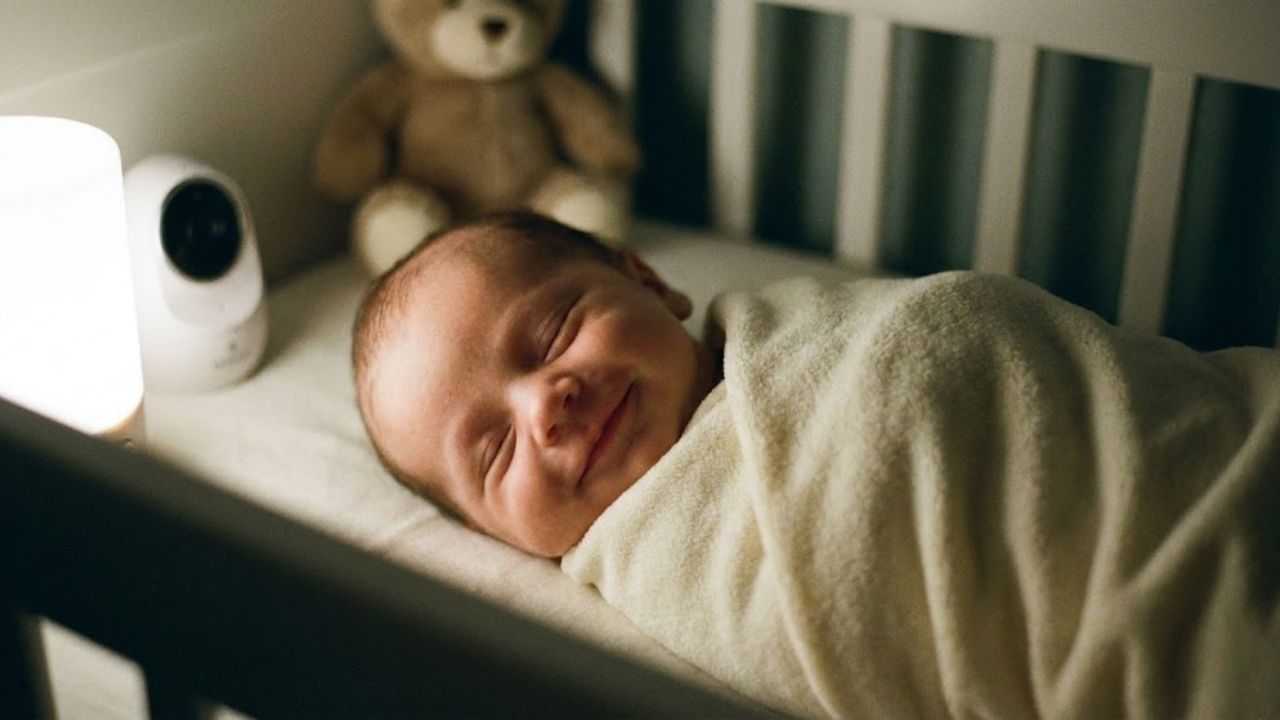
It is 2:00 AM. The house is silent, save for the hum of the refrigerator and the soft white noise machine in the nursery. You are exhausted, staring at the baby monitor for the tenth time this hour, just checking. And then you see it: a tiny, perfect smile spreading across your newborn’s face.
It is a moment that melts the hearts of even the most sleep-deprived parents. But then the questions start. We know what the baby staring means. But what about the baby sleep smiling? Are they dreaming about me? Did they just pass gas? Is this normal?
The Midnight Grin: What Exactly Does It Mean When a Baby Smiles in Their Sleep?
For generations, grandmothers have waved a hand and declared, “Oh, that’s just gas.” But modern science suggests something much more profound—and much sweeter—is happening behind those closed eyelids. At Clever Bee Academy, we believe that understanding the “why” behind your child’s behaviors helps you connect more deeply with them.

In this guide, we will journey into the fascinating neuroscience of infant sleep, debunk the “gas” myth, and explore what those secret smiles tell us about your baby’s developing brain.
The Science of the “Sleep Grin”
To understand why babies smile in their sleep, we first have to understand how differently they sleep compared to adults.
When you sleep, you cycle through several stages, eventually landing in Rapid Eye Movement (REM) sleep, which is where dreaming happens. For adults, REM accounts for about 20% of our sleep. For newborns, however, REM sleep (often called “Active Sleep”) makes up about 50% of their total sleep time.
During this Active Sleep phase, a baby’s brain is firing on all cylinders. It is busy building neural pathways, processing the sensory input from the day, and testing out the body’s “equipment.” This is why you often see babies twitch, jerk, suck, and yes—smile—while they are completely asleep.
According to the University of Rochester Medical Center, these movements are a normal part of the development of the nervous system. The smile is often a subcortical reflex, meaning it comes from the lower part of the brain that controls automatic functions, rather than the emotional center. But just because it is a reflex doesn’t mean it isn’t important. It is a sign that your baby’s brain stems and nerves are firing exactly as they should.
The Timeline of a Smile: A Developmental Roadmap
Not all smiles are created equal. As your baby grows from a newborn into an infant, the meaning behind their grin evolves. Here is a breakdown of the three distinct stages of smiling:
1. The Reflexive Smile (0 – 6 Weeks)
This is what you are likely seeing in those first few hazy weeks. These smiles are:
-
Brief and random: They happen quickly and don’t seem triggered by anything specific.
-
Internal: They are a physical reaction, not an emotional one.
-
Occur mostly during sleep: This is the brain “exercising” the facial muscles.
2. The Responsive Smile (6 – 8 Weeks)
Around the two-month mark, the magic shifts. Your baby starts to smile in response to sensory experiences.
-
Triggered by pleasure: They might smile at a high-pitched voice, a gentle tickle, or a familiar face.
-
Awake smiling: You will start seeing these grins when their eyes are open.
-
The beginning of social bonding: This is the brain linking “cause” (Mommy’s voice) with “effect” (feeling good).
3. The Social Smile (3 Months and Beyond)
This is the game-changer.
-
Intentional: Your baby is smiling at you to get a reaction.
-
Communicative: They use the smile to say, “I like this,” or “Play with me.”
-
Whole-face engagement: The eyes crinkle, the mouth opens, and sometimes a little gurgle comes out.
Dispelling the “Gas” Myth
We have all heard it: “Don’t get too excited, honey, it’s just wind.”
While it is true that babies make all sorts of faces when they are working on digestion (including grimacing and straining), the idea that every smile is a result of gas is largely a myth.
Think about it: when you have gas pain or are uncomfortable, do you smile? Probably not. You grimace. Babies are the same. If they are in pain from trapped wind, they are more likely to frown, squirm, or cry. A relaxed, peaceful smile is rarely a sign of digestive distress. It is much more likely to be a sign of physical comfort—a full belly, a warm swaddle, and a safe environment.
Do Babies Dream?
If they are smiling in REM sleep, does that mean they are having happy dreams?
This is one of the great mysteries of pediatric neuroscience. Since babies cannot tell us about their night, we can only hypothesize. Researchers from Harvard University’s Center on the Developing Child emphasize that the brain architecture is being built from the bottom up during these early months.
While babies likely don’t dream in “stories” like adults do (they don’t have language or complex concepts yet), they almost certainly dream in sensations.
-
They might be “dreaming” of the sound of your voice.
-
They might be processing the smell of milk.
-
They might be reliving the feeling of being rocked.
So, when that smile creeps across their face, it is entirely possible they are re-experiencing a feeling of safety and love that you provided them earlier that day.
When to Pay Closer Attention
While sleep smiling is almost always a sign of a healthy, developing nervous system, there are rare instances where rhythmic movements can indicate an issue.
It is important to distinguish between “sleep myoclonus” (healthy sleep twitches) and seizures.
-
Healthy Sleep Smiles: Occur when the baby is asleep, look peaceful, and stop if you gently wake the baby or touch them.
-
Concern Signs: If the smiling or twitching is rhythmic (happening over and over in a set pattern), if the baby’s eyes are open but blank, or if the movements don’t stop when you gently touch them.
If you are ever unsure, the best thing to do is take a video of the behavior and show it to your pediatrician. But for the vast majority of parents, the midnight grin is simply a beautiful biological milestone.
Encouraging Happy Sleep Habits
We know that better sleep for the baby means better sleep for the parents. At Clever Bee Academy, we integrate healthy sleep hygiene into our infant programs to ensure children feel secure enough to rest deeply.
Here are three ways you can foster an environment that leads to those peaceful, smiley nights:
1. The “Drowsy but Awake” Practice
Try to put your baby down when they are heavy-lidded but not fully asleep. This helps them learn to self-soothe, so when they wake up between sleep cycles (which is when those smiles often happen), they can drift back off without panic.
2. Curate the Sensory Environment
Babies are sensory sponges.
-
Sound: Use a white noise machine to mimic the constant “whoosh” of the womb.
-
Touch: Ensure the room is cool (between 68-72°F) and use a swaddle (for younger babies) to prevent the startle reflex from waking them up.
3. Connection Before Correction
If your baby wakes up fussing, give them a moment. Sometimes they are just transitioning between Active Sleep and Quiet Sleep. Rushing in too quickly can actually wake them up fully. Listen for the difference between a “fussy” cry and a “need” cry.
For more resources on child development and parenting strategies, Penn State Extension offers excellent, research-based guides.
Understand Baby Sleep Smiles: The Secret Language of Sleep
The next time you catch your little one smiling in their sleep, don’t dismiss it as “just a reflex” or “just gas.”
That smile is a signal. It is a signal that their brain is growing, their connections are forming, and their body feels safe enough to practice the art of joy. It is a private moment between your baby and their own developing world—a world you are helping to build every day with your love and care.
Parenting is full of exhaustion, but it is these fleeting, quiet moments that refuel us. They remind us that even when we feel like we are just surviving, our children are thriving.
Do you have questions about your child’s developmental milestones? At Clever Bee Academy, we are more than just a daycare; we are a partner in your parenting journey. Whether you need advice on sleep schedules or want to know more about our infant curriculum, we are here to help.
Contact Clever Bee Academy today to speak with one of our educators or schedule a visit. Let’s build a happy, healthy future for your little one—together.