As a parent, few moments are as magical as hearing your child’s very first words. From those early babbles to their first “mama” or “dada,” communication is the foundation of how children connect with you and the world around them. But what happens when those milestones are delayed? If your child is struggling to pronounce words, express their thoughts, or understand directions, it can be incredibly stressful. You want to give them the best possible support, but figuring out where to start can feel overwhelming.
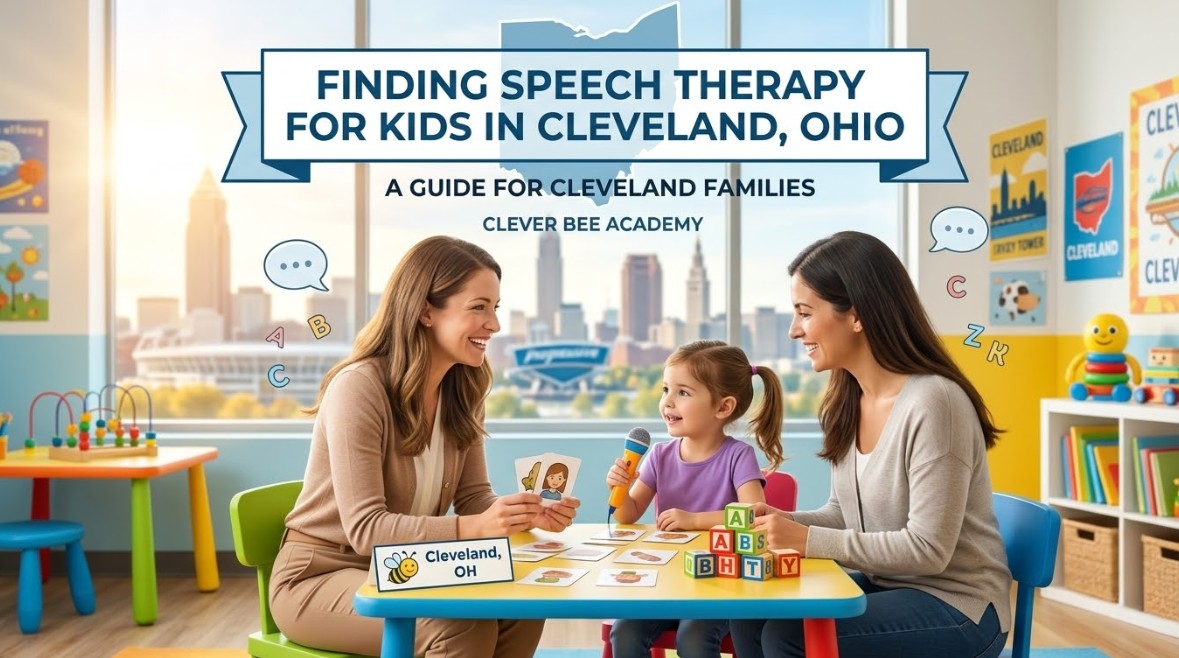
If you are raising a family in Northeast Ohio and looking for guidance, you are in the right place. Welcome to the Ultimate Guide to Finding the Best Speech Therapy for Kids in Cleveland, Ohio. Whether you are noticing the first signs of a speech delay or are looking to transition to a more integrated therapeutic environment, this comprehensive guide from Clever Bee Academy will help you navigate the process with confidence and clarity.
What is Pediatric Speech Therapy?
When most people hear “speech therapy,” they think of helping a child fix a lisp or stop stuttering. While articulation and fluency are certainly key components, pediatric speech-language pathology is much broader than that.
Speech therapy addresses two main areas: speech (how your child says sounds and words) and language (how your child understands others and expresses their own ideas). A pediatric speech-language pathologist (SLP) works with children to improve vocal quality, vocabulary, sentence structure, listening comprehension, and even social communication skills like making eye contact and taking turns in a conversation. Furthermore, because the same muscles used for speaking are used for eating, speech therapists also often assist children who have swallowing or feeding aversions.
5 Signs Your Child Might Benefit from Speech Therapy
Every child develops on their own unique timeline. A toddler who is a “late talker” doesn’t automatically require therapy, but early intervention is proven to be the most effective way to address developmental hurdles.
How do you know if it is time to seek a professional evaluation? Look out for these common indicators:
-
Missed Milestones: Not babbling by 9 months, not saying their first words by 15 months, or not speaking in two-word phrases by age two.
-
Difficulty Being Understood: If strangers or even family members cannot understand what your child is saying by the time they are three years old.
-
Stuttering or Dysfluency: Repeating sounds, syllables, or words excessively, or showing physical tension when trying to speak.
-
Receptive Language Struggles: Difficulty following simple directions, answering basic questions, or pointing to objects when named.
-
Social Communication Challenges: Struggling to interact with peers, avoiding eye contact, or not responding when their name is called.
Step-by-Step Guide to Finding the Best Speech Therapy in Cleveland
1. Consult Your Pediatrician for an Initial Screening Your first step should always be to share your concerns with your child’s primary care physician. They can conduct a preliminary hearing test (to rule out fluid or ear infections that might be causing a temporary delay) and provide a referral to a trusted speech-language pathologist in the Cleveland area.
2. Utilize Ohio Government and Early Intervention Resources Navigating therapy costs and logistics can be daunting, but Ohio offers excellent public resources for families. If your child is under three years old, reach out to the Ohio Early Intervention (EI) program. This statewide system provides free, coordinated services and evaluations to eligible infants and toddlers, often taking place right in your home. For children aged three and older, the Ohio Department of Education and Workforce handles preschool and school-aged special education services. Your local Cleveland public school district can conduct evaluations to see if your child qualifies for an Individualized Education Program (IEP) that includes free speech therapy services.
3. Verify Credentials and Find the Right Fit When researching private clinics or educational centers, ensure the therapists hold a Certificate of Clinical Competence in Speech-Language Pathology (CCC-SLP) from the American Speech-Language-Hearing Association (ASHA) and are licensed by the State of Ohio. Look for providers who specialize in pediatrics and have experience with your child’s specific needs.
4. Look for an Integrated Learning Environment Children learn best when they feel safe and comfortable. While clinical settings work for some, many children thrive when therapy is integrated directly into their daily routine. Receiving therapy at a familiar childcare or early education center reduces the stress of traveling to multiple appointments and allows therapists to collaborate directly with your child’s teachers.
Spotlight on Clever Bee Academy in Cleveland
At Clever Bee Academy, we know that communication is the key to a child’s confidence and success in the classroom. For parents in Northeast Ohio, balancing work, childcare, and weekly therapy appointments can be exhausting. That is why our Cleveland location is designed to bridge the gap between high-quality early childhood education and specialized therapeutic support.
Our Clever Bee Academy Cleveland campus offers a warm, inclusive, and highly engaging environment tailored to support early childhood development. Conveniently located for local families, our facility features interactive classrooms and dedicated spaces where children can receive the individualized support they need without ever leaving their school day. Our teachers and allied therapy professionals work as a unified team. When a child learns a new communication skill or speech strategy during their therapy session, our classroom educators actively reinforce that skill during playtime, storytime, and social interactions.
If you are searching for an educational home that truly understands and supports your child’s communication journey, we are here for you. You can learn more about our specialized programs, our expert staff, and how we integrate daily learning with therapeutic goals by visiting our page dedicated to speech therapy for children in Cleveland, OH. Together, we can help your child find their voice.
4 General Tips for Supporting Speech Development at Home
Speech therapy is most effective when the strategies are carried over into the home. Here are some simple ways you can encourage your child’s language development every day:
-
Read Together Daily: Books are incredible tools for language building. Point to pictures, name objects, and ask your child simple questions about the story.
-
Narrate Your Day: Talk through your daily routines. Say things like, “Now we are putting on our red shoes!” or “Let’s wash the green apples.” This constant exposure to vocabulary is highly beneficial.
-
Get Down to Their Level: When you talk to your child, kneel or sit down so you are face-to-face. This helps them see how your mouth moves to form sounds and encourages better eye contact.
-
Give Them Time to Answer: When you ask a question, pause for at least 5 to 10 seconds. Children with processing delays often just need a little extra time to formulate their response.
4 Frequently Asked Questions (FAQ)
- Q: How long will my child need speech therapy? A: The duration of therapy varies wildly depending on the child and the severity of the delay. Some children with mild articulation issues may only need a few months of therapy, while children with complex developmental or neurological conditions may benefit from ongoing support for several years.
- Q: What is the difference between receptive and expressive language? A: Receptive language refers to a child’s ability to understand information, words, and gestures (e.g., following an instruction to “go get your coat”). Expressive language refers to a child’s ability to put thoughts into words and sentences to communicate their needs and ideas to others.
- Q: Should I correct my child every time they mispronounce a word? A: No, over-correcting can lead to frustration and make your child hesitant to speak. Instead, use a technique called “modeling.” If your child says, “Look at the big tat,” you can simply reply with positive reinforcement and the correct pronunciation: “Yes, that is a very big cat!”
- Q: Can bilingual households cause a speech delay? A: This is a common myth! Raising a child in a bilingual home does not cause speech or language delays. While a bilingual child might occasionally mix words from both languages in the same sentence (known as code-switching), their overall language acquisition milestones should remain the same as monolingual children.
Our Final Thoughts on Finding the Top Speech Therapy for Kids in Cleveland
Helping your child overcome a communication hurdle is one of the most proactive and loving things you can do as a parent. By consulting with your pediatrician, utilizing Ohio’s early intervention resources, and finding an integrated, supportive environment like Clever Bee Academy in Cleveland, you are laying a strong foundation for your child’s future.
Every child has a unique, beautiful voice, and sometimes they just need a little extra help learning how to use it.