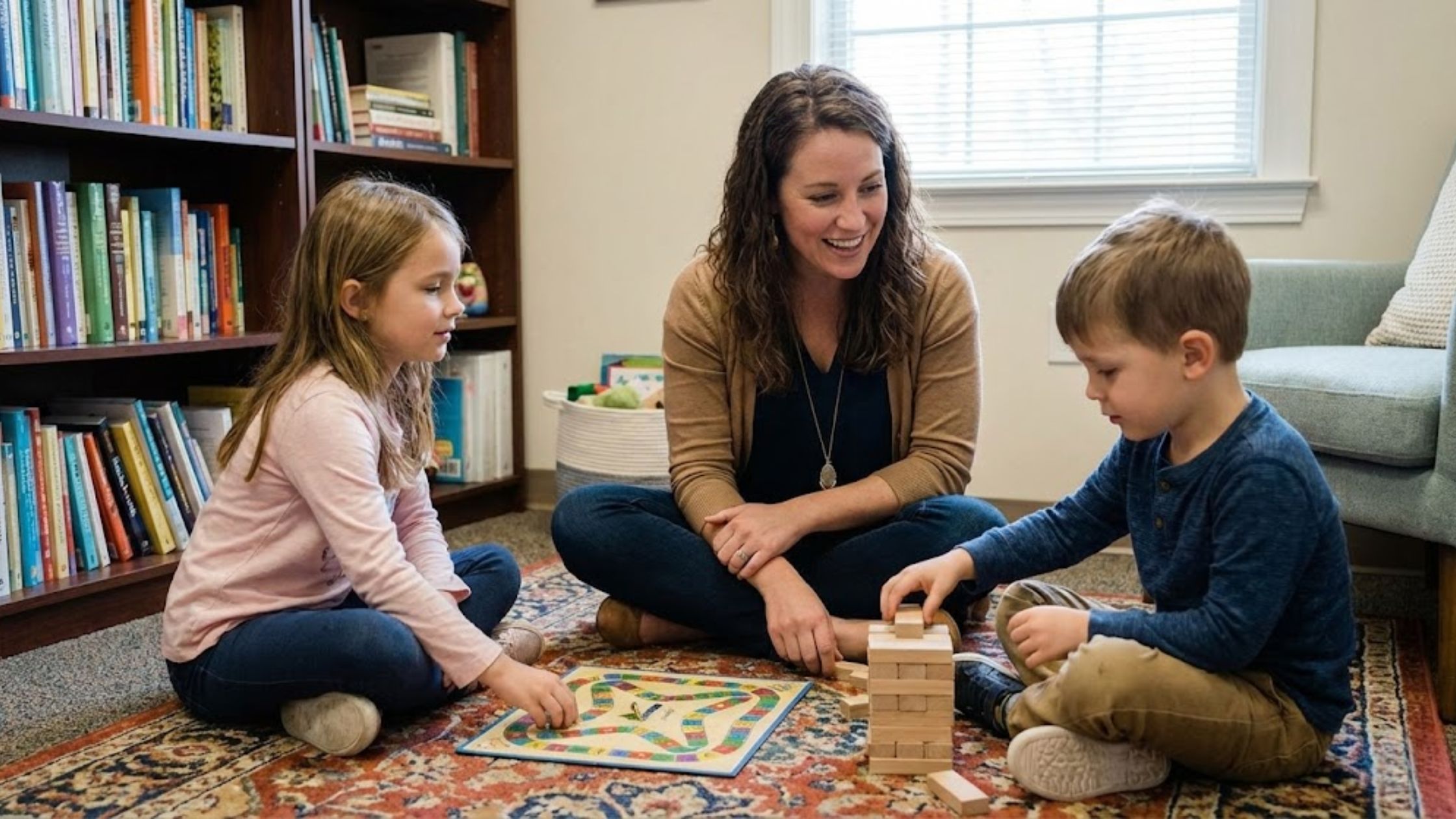
Picture this: 5-year-old Leo sits at the kitchen table, angrily crumbling a piece of paper because he can’t find the words to say he’s jealous of his new baby sister. Meanwhile, 9-year-old Mia comes home from school quiet and withdrawn, carrying the weight of a playground argument she doesn’t know how to process.
These moments happen in every home. As parents and educators, we often rush to “fix” the problem with words, asking “What’s wrong?” or “Use your words.” But for many children, words are simply not enough. This is where art becomes a powerful language of its own.
Art therapy activities aren’t just about making pretty pictures to hang on the fridge; they are about providing a safe outlet for complex emotions that children—whose vocabularies are still developing—often struggle to articulate. At Clever Bee Academy, our educators have seen firsthand how creative expression can unlock a child’s inner world, transforming anxiety and frustration into confidence and calm.
This kids art therapy guide explores research-backed strategies, age-appropriate activities, and practical ways you can bring the healing power of art into your home. Whether you have a sensory-seeking toddler or a moody pre-teen, these insights will help you nurture their emotional health through creativity. For more kids activitites, check out our kids’ games therapy guide here.
Understanding Art Therapy for Children in 2026
It is important to distinguish between “art class” and “art therapy activities.” In an art class, the focus is often on the product—making a realistic dog or staying within the lines. In therapeutic art, the focus is entirely on the process.
When a child is allowed to smash clay, mix “ugly” colors, or draw a scribbly storm, they are externalizing their internal state. This process provides a sense of control and relief.
The early years are critical for emotional development. Research from Husson University highlights that art therapy can significantly improve self-esteem and reduce anxiety by allowing individuals to explore feelings they cannot yet verbalize. When we give children the tools to express themselves artistically, we are giving them a lifelong coping mechanism.
Age-Appropriate Art Therapy Activities by Development Stage
Just as you wouldn’t expect a toddler to read a novel, therapeutic art activities should be matched to your child’s developmental stage.
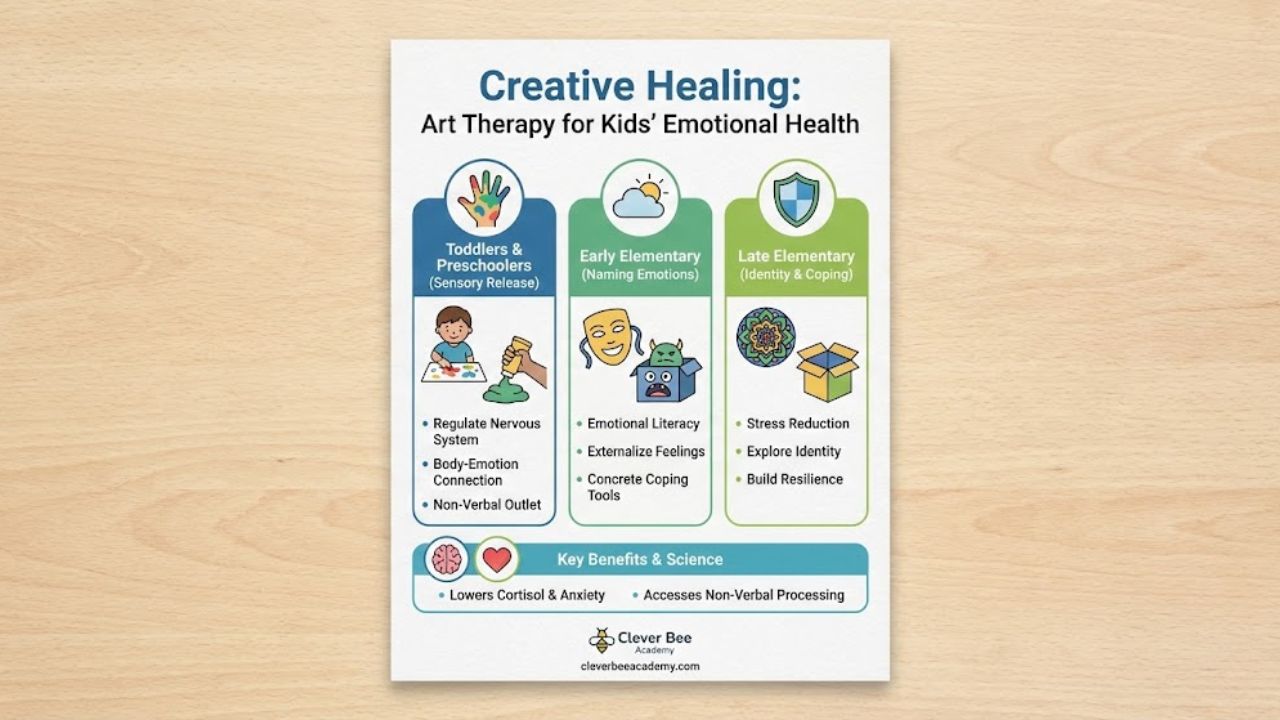
Toddlers and Preschoolers: Sensory and Somatic Release
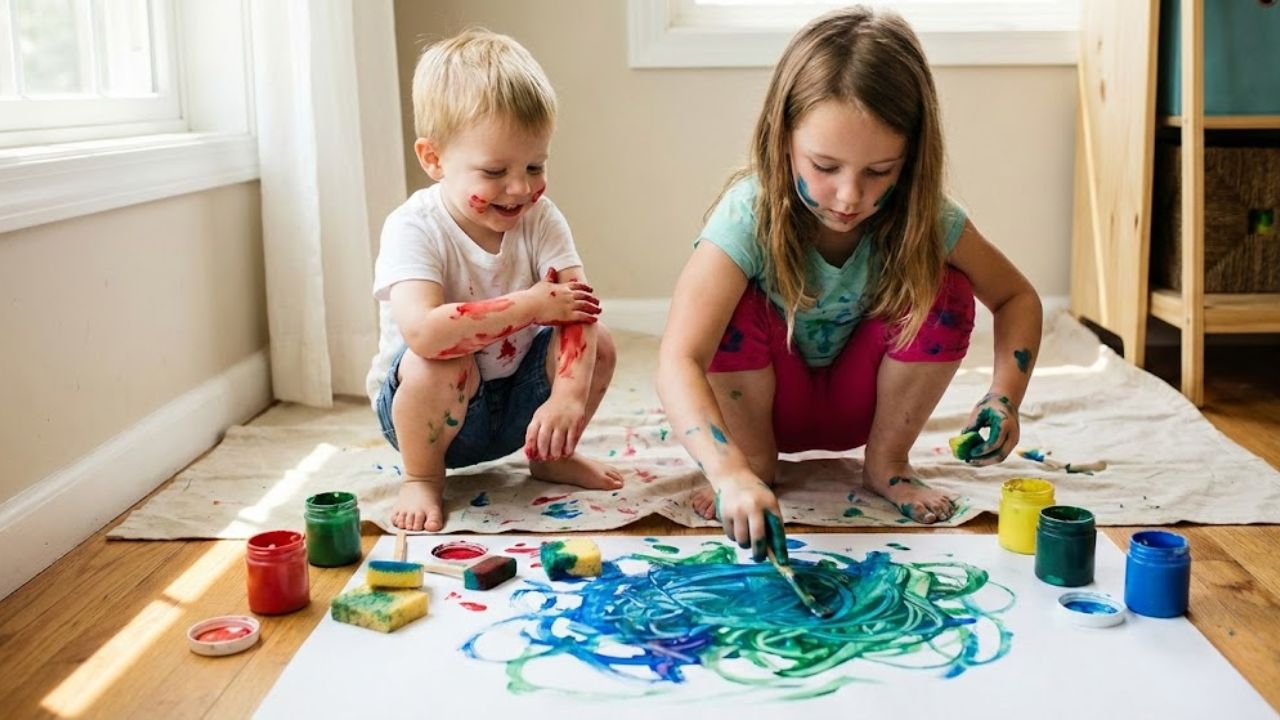
For this age group, art is a physical experience. They are learning how their bodies move and how they can impact their environment. The goal here is sensory regulation. Here are 3 art therapy for kids ideas to try today:
-
Finger Painting to Music: This combines auditory and tactile stimulation. Play different types of music—slow and calming, then fast and energetic—and encourage your child to paint the “rhythm.” This helps them connect physical sensation with emotional shifts.
-
The “Slam” Clay Station: Toddlers often get frustrated but lack the impulse control to manage it. Provide a lump of non-toxic clay or playdough and allow them to pound, flatten, and squeeze it. The University of California, Irvine notes that such sensory-based art therapy is particularly effective for regulating sensory input and calming the nervous system, especially in children who may be easily overstimulated.
-
Texture Collages: Let them glue different textures (cotton balls, sandpaper, crinkled tissue) onto cardboard. Ask simple questions like, “Which one feels like a hug?” or “Which one feels scratchy like a bad mood?”
Early Elementary: Naming and Taming Emotions
As children enter school, their social world expands, and so do their complex feelings. At this stage, art therapy activities for kids should focus on emotional literacy—identifying and naming feelings.
-
The Emotion Mask: Give your child a blank paper plate or mask template. Ask them to paint a face that shows how they feel on the outside (what they show their friends) and on the inside (how they really feel). This opens a door to discuss how it’s okay to feel sad even when we are smiling.
-
Weather Report Drawings: Ask your child to draw their “internal weather.” Are they sunny? Is there a tornado of worry? Is it foggy? This metaphor helps children understand that emotions are temporary—just like the weather, a storm will pass.
-
The Worry Monster Box:
-
Step 1: Find an old shoe box or tissue box.
-
Step 2: Decorate it to look like a hungry monster.
-
Step 3: Have your child draw or write down their worries on small slips of paper.
-
Step 4: Feed the worries to the monster.
-
Why it works: This physicalizes the act of letting go of anxiety, making the abstract feeling of “worry” something concrete they can dispose of.
-
Late Elementary: Identity and Coping Skills
Older children face increased academic pressure and social hierarchy navigation. Their art therapy activities can be more abstract, focusing on identity and stress relief.
-
Mandala Meditation: Drawing or coloring Mandalas (circles with repeating patterns) creates a state of focused attention similar to meditation. It allows the brain to rest and refocus.
-
“Inside-Out” Boxes: Similar to the mask, but more complex. The outside of the box is decorated with words and images of how the world sees them (e.g., “Student,” “Soccer Player”). The inside is filled with things that represent their true self (e.g., “Dreamer,” “Anxious,” “Loves Dragons”). This validates their complex identity.
-
The Safety Shield: Have them draw a large shield. Inside the shield, they should draw or write the things that make them feel safe and strong (e.g., “My dog,” “Reading,” “Mom’s hugs”). This serves as a visual reminder of their support system during tough times.
3 Daily Art Therapy Practices: Building Routines
You don’t need a scheduled “therapy hour” to see benefits. Integrating small moments of creativity into your daily routine can act as an emotional pressure valve.
-
The “After-School Decompression” Sketch: Instead of immediately asking “How was school?”, place a large notepad and markers on the table. Let them doodle for 10 minutes. You might be surprised to see jagged lines turn into softer waves as they relax.
-
Gratitude Graffiti: Tape a large piece of paper to a wall or door. Every evening, have family members draw or write one thing they were grateful for that day.
-
Sunday Art Hour: Replace one hour of screen time with “open studio” time. Put out diverse materials—paints, recycled cardboard, glue, old magazines—and let the family create side-by-side. The shared silence and creativity can strengthen bonds without the pressure of conversation.
The Science Behind Art and Emotional Health
Why does this work so well? It’s not magic; it’s neuroscience.
When a child is stressed, their brain releases cortisol, and their “fight or flight” response is activated. Engaging in creative activities has been shown to lower cortisol levels. Furthermore, traumatic or difficult memories are often stored in the non-verbal parts of the brain. Talk therapy requires accessing the left (logical) hemisphere, which can be offline during distress. Art accesses the right hemisphere, allowing children to process emotions without needing to find the “right words” immediately.
According to Michigan State University Extension, art therapy provides a unique vehicle for children to resolve conflicts and problems, develop interpersonal skills, and manage behavior in a way that traditional verbal methods sometimes cannot.
4 Ways for Measuring Progress and Success with Your Children’s Art Therapy Sessions:
How do you know if these activities are working? Unlike a math test, there is no grade for a “Worry Monster.” However, you can look for these behavioral shifts:
-
Increased Emotional Vocabulary: Your child starts saying, “I feel like a storm today,” rather than just throwing a toy.
-
Self-Regulation: They retreat to their art corner when upset instead of having a meltdown.
-
Openness: They begin to tell you the story behind their drawing, revealing feelings they hadn’t shared before.
-
Calmness: You notice a visible physical relaxation (dropped shoulders, slower breathing) while they are creating.
Expert Art Therapy Tips for Parents & Kids
We asked our educators at Clever Bee Academy for their top tips on facilitating art at home. Here is what they recommend:
-
Focus on the Process, Not the Product: Never critique the artwork. Avoid saying, “That doesn’t look like a horse.” Instead, say, “I see you used a lot of red energy in those lines. Tell me about that.”
-
Be a Co-Creator: Sit down and draw your feelings too. Children learn by modeling. If they see you using art to relax, they will do the same.
-
Allow the “Ugly”: If your child draws dark, scary, or messy pictures, don’t correct them. This is the art doing its job—getting the scary feelings out of the child and onto the paper.
-
Create a “Yes” Space: Use washable materials and cover tables so you don’t have to say “Don’t make a mess” constantly. The freedom to make a mess is part of the therapy.
Our Final Thoughts on Kids’ Art Therapy: Painting a Brighter Future
Incorporating art therapy for kids activities into your child’s life is one of the most loving ways to support their mental health. It gives them a voice when they have none and a safe place to land when the world feels overwhelming.
Remember, you don’t need to be an artist or a therapist to help your child heal. You just need to provide the paper, the crayons, and the space for them to be themselves.
Ready to give your child an environment where their emotional and social growth is prioritized? At Clever Bee Academy, we believe in the whole child—nurturing their hearts just as much as their minds. Our curriculum integrates creative play and emotional support to ensure every child can thrive.