
Identifying shapes is a fundamental cognitive milestone, similar to kids learning colors or learning to count, that bridges the gap between visual perception and early mathematics. While a 1-year-old may seem merely to be scribbling, they are actually beginning a complex journey of geometric understanding that evolves rapidly between the ages of 2 and 6.
This detailed guide outlines the developmental timeline for learning shapes, dividing the process into identification (recognizing) and reproduction (drawing), which happen at very different rates.
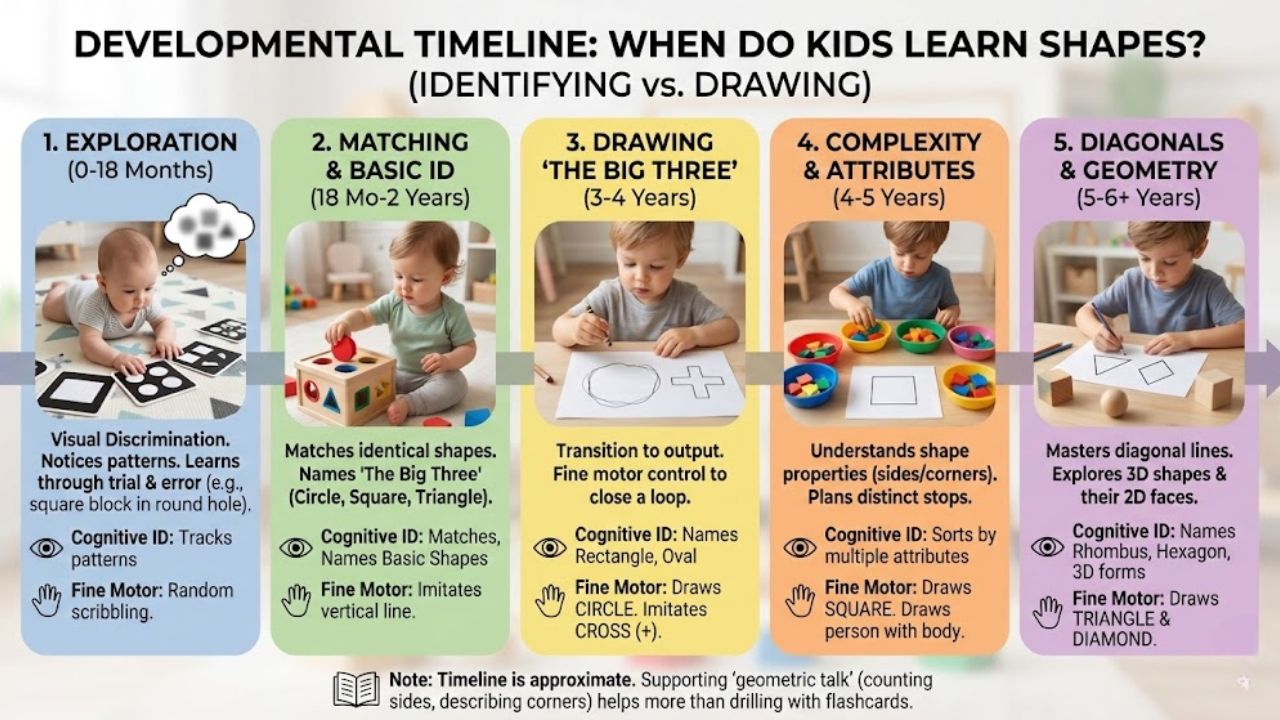
The Shape Learning Timeline for Children
Children do not learn all shapes at once. The process follows a specific hierarchy, moving from simple, continuous forms (like circles) to those with complex intersecting lines (like triangles and diamonds).
Stage 1: Exploration & Visual Discrimination (0–18 Months)
Before children can name shapes, they must learn to visually distinguish them. This “visual discrimination” is the precursor to all geometry.
-
0–5 Months: Infants focus on high-contrast patterns and simple outlines. They begin to track moving objects.
- 6–18 Months: Toddlers notice differences in form. They may try to force a square block into a round hole, learning through trial and error that “corners don’t fit in curves.”
-
Milestone: By 15 months, a child might not name a “circle” but clearly prefers round objects (balls) over sharp ones.
Stage 2: Matching & Basic Identification (18 Months – 2 Years)
This is where active sorting begins. The concept of “same” vs. “different” solidifies.
-
18–24 Months: A child can match identical shapes. If you hold up a plastic circle and ask them to find one just like it from a pile, they can succeed.
-
2 Years: Most children can identify and name the “Big Three”: Circle, Square, and Triangle.
-
Common Error: At this age, children often over-generalize. They might call an oval a “circle” or a rectangle a “square” because they are looking at the general curvature or number of sides rather than specific properties.
Stage 3: Naming & Drawing “The Big Three” (3–4 Years)
At age 3, a significant leap occurs: the transition from input (recognition) to output (drawing/reproduction).
-
Recognition: Three-year-olds can typically identify a circle, square, triangle, and rectangle reliably. They begin to understand that a square is still a square even if it is turned on its side (though this “shape constancy” is still developing).
-
Drawing Milestone (The Circle): Around age 3, children gain the fine motor control to close a loop. They will stop scribbling and draw a distinct, enclosed circle.
-
Drawing Milestone (The Cross): By 3.5 to 4 years, children can draw intersecting lines (+) which is the prerequisite for drawing squares.
Stage 4: Complexity & Attributes (4–5 Years)
Children begin to understand why a shape is a shape (e.g., “It has three points”).
-
Drawing Milestone (The Square): By age 4, children can typically draw a square.5 This is difficult because it requires planning four distinct stops and changes in direction.
-
Identification: They can now name more complex shapes like ovals, stars, and hearts.
-
Sorting: They can sort objects by multiple attributes—for example, putting all “small red triangles” in one pile.
Stage 5: Diagonals & Geometry (5–6 Years)
The final preschool milestone involves diagonal lines, which require crossing the midline of the body and advanced visual-motor planning.
-
Drawing Milestone (The Triangle): While they can identify triangles at age 2, most children cannot accurately draw a recognizable triangle until age 5.
-
Drawing Milestone (The Diamond/Rhombus): This is often the final shape in early developmental screenings, typically mastered around age 6.
-
Geometry: Kindergarteners begin to work with 3D shapes (cube, sphere, cylinder) and understand that these solids are made of flat 2D shapes (faces).
Specific Shape Learning Developmental Milestones by Age 0-6
| Age | Identification Skill (Cognitive) | Drawing Skill (Fine Motor) |
| 12-18 Mos | Matches same objects; puts circle in puzzle. | Random scribbling. |
| 2 Years | Names Circle, Square, Triangle. | Imitates a vertical line. |
| 3 Years | Names Rectangle, Oval. Matches complex shapes. | Copies a Circle. Imitates a cross (+). |
| 4 Years | Identifying shapes by attributes (sides/corners). | Copies a Square. Draws a person (head/legs). |
| 5 Years | Names Rhombus, Trapezoid, Hexagon. | Copies a Triangle. Prints some letters. |
| 6 Years | Identifies 3D shapes (Cube, Cone). | Copies a Diamond. |
Additional Resources
For further reading on cognitive development and early mathematics, refer to these academic sources:
-
Stanford University – Development and Research in Early Math Education (DREME)
-
Topic: What Children Know and Need to Learn about Shape and Space
-
Relevance: A comprehensive breakdown of how children perceive sameness, difference, and classification of geometric forms from birth to age 5.
-
-
University of North Carolina – Frank Porter Graham Child Development Institute
-
Topic: Early Learning Progressions: Recognizes Geometric Shapes
-
Relevance: Provides a specific progression chart for children aged 54-60 months, detailing how they learn to name and analyze shape attributes.
-
-
Fort Hays State University (Open Educational Resources)
-
Relevance: An academic text detailing the specific mathematical milestones, including spatial reasoning and shape sorting, for infants through early elementary students.
-
Erikson Institute – Early Math Collaborative
-
Relevance: Explores the foundational concepts of shape and space, offering research-backed insights into how identifying shapes supports later problem-solving skills.
-
Rasmussen University – School of Education
-
Relevance: A broader overview of cognitive milestones that places shape learning within the context of general brain development and school readiness.
How to Support Shape Learning at Home for Kids:
Understanding the timeline helps parents set realistic expectations. You can support this development through “geometric talk” rather than drilling with flashcards.
-
Go Beyond Naming: Instead of just asking “What shape is this?”, ask “How do you know it’s a triangle?” This encourages the child to count the points and sides.
-
Focus on Properties: When playing with blocks, use vocabulary like edge, corner, curved, and straight. Research shows that children who hear spatial language perform better in math later in life.
-
Tracing Before Drawing: If a 3-year-old is frustrated trying to draw a square, let them trace a plastic square or use their finger to draw it in a tray of sand or shaving cream. This builds muscle memory without the pressure of pencil control.
-
Real World Hunting: Point out that a door is a rectangle, a clock is a circle, and a yield sign is a triangle. This helps children understand that shapes exist in the real world, not just in books.